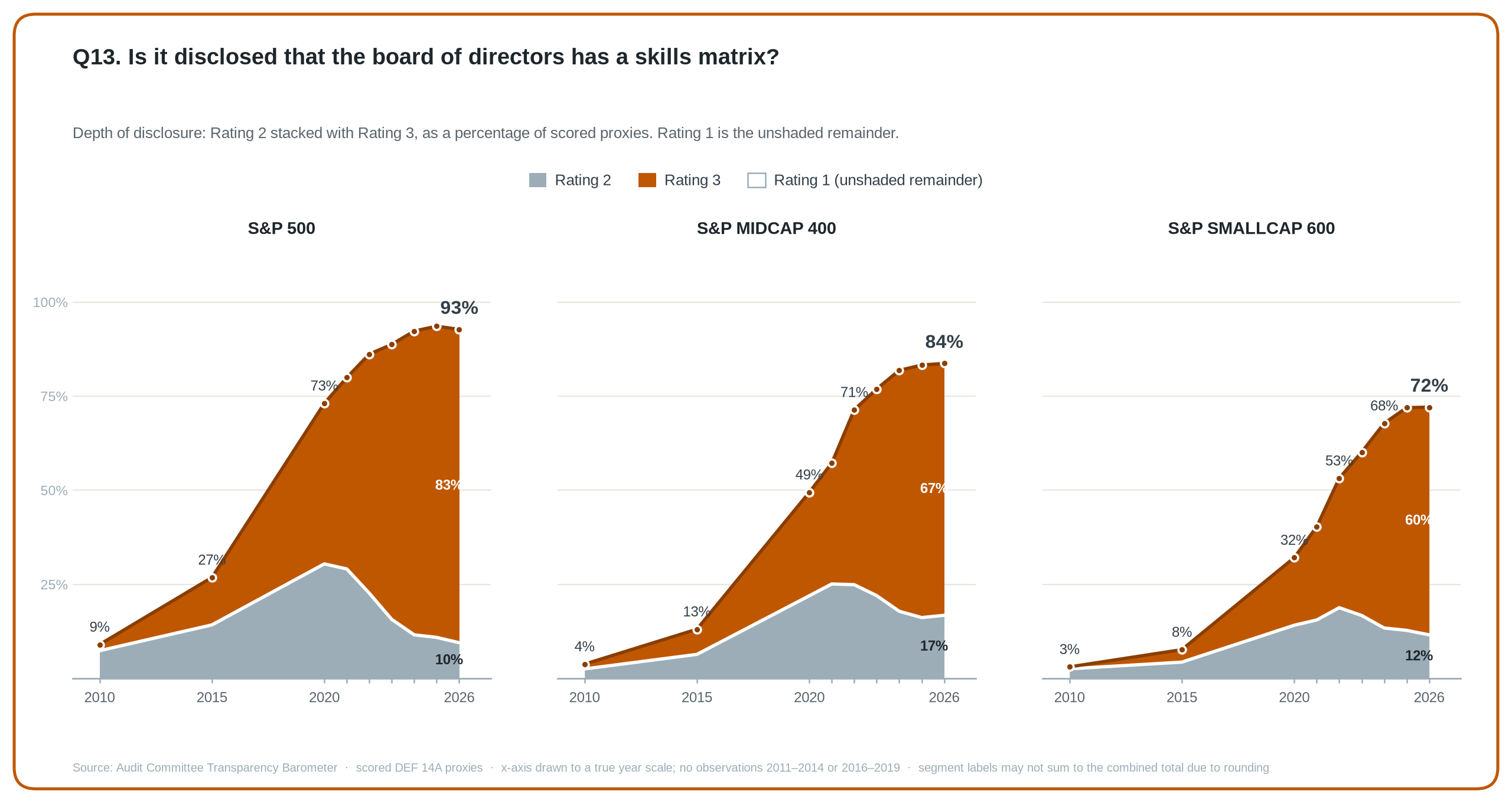
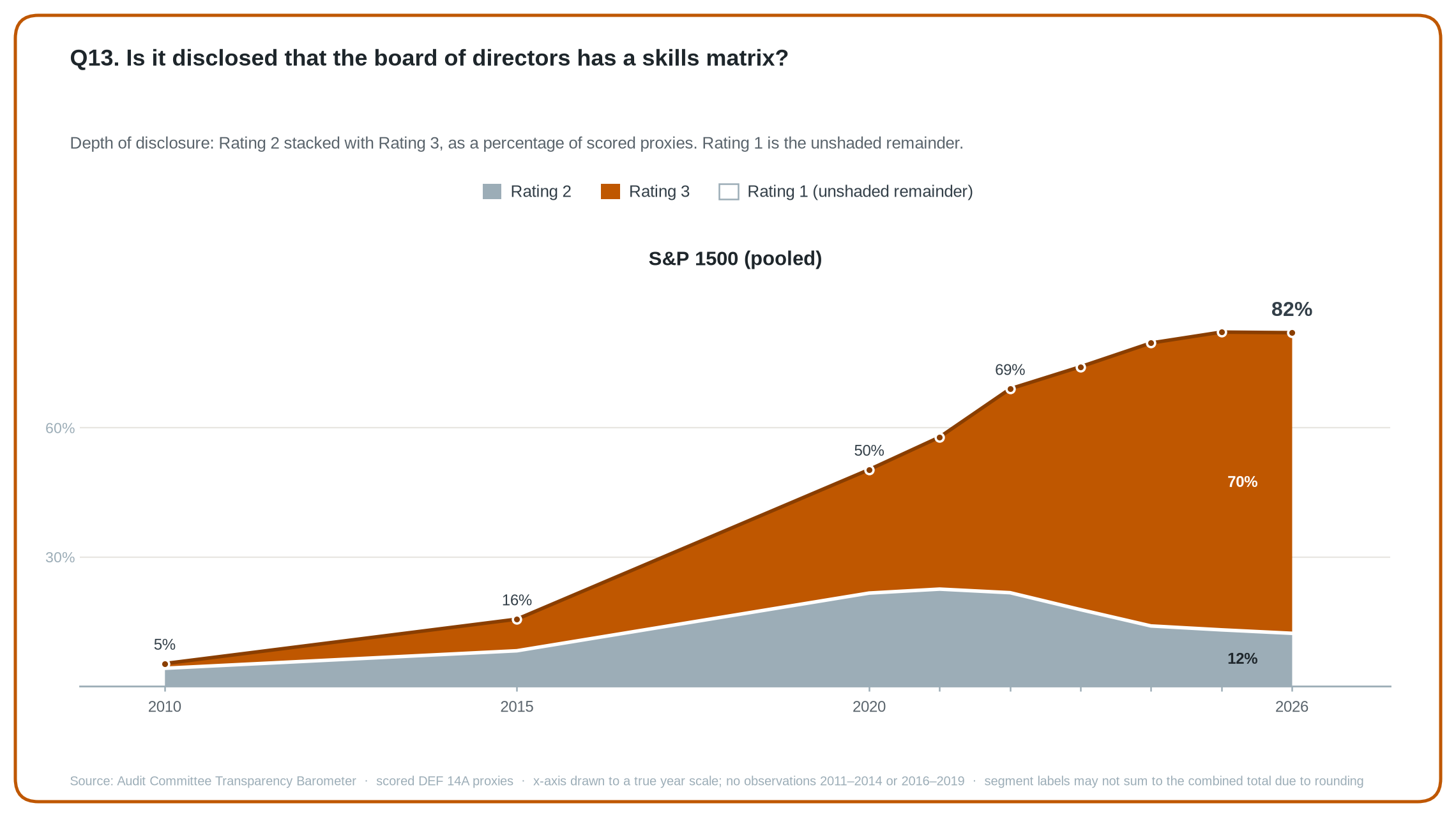
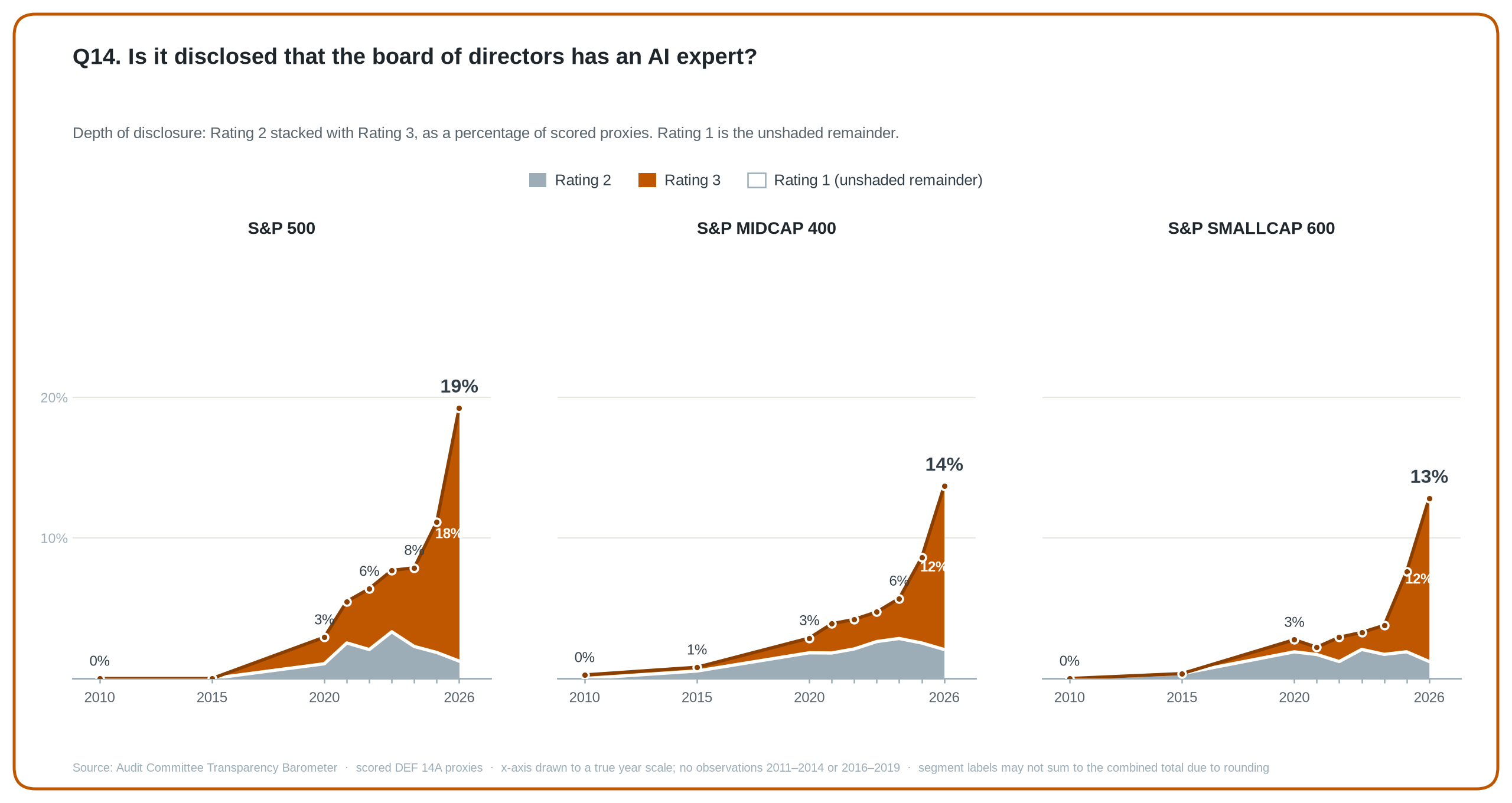
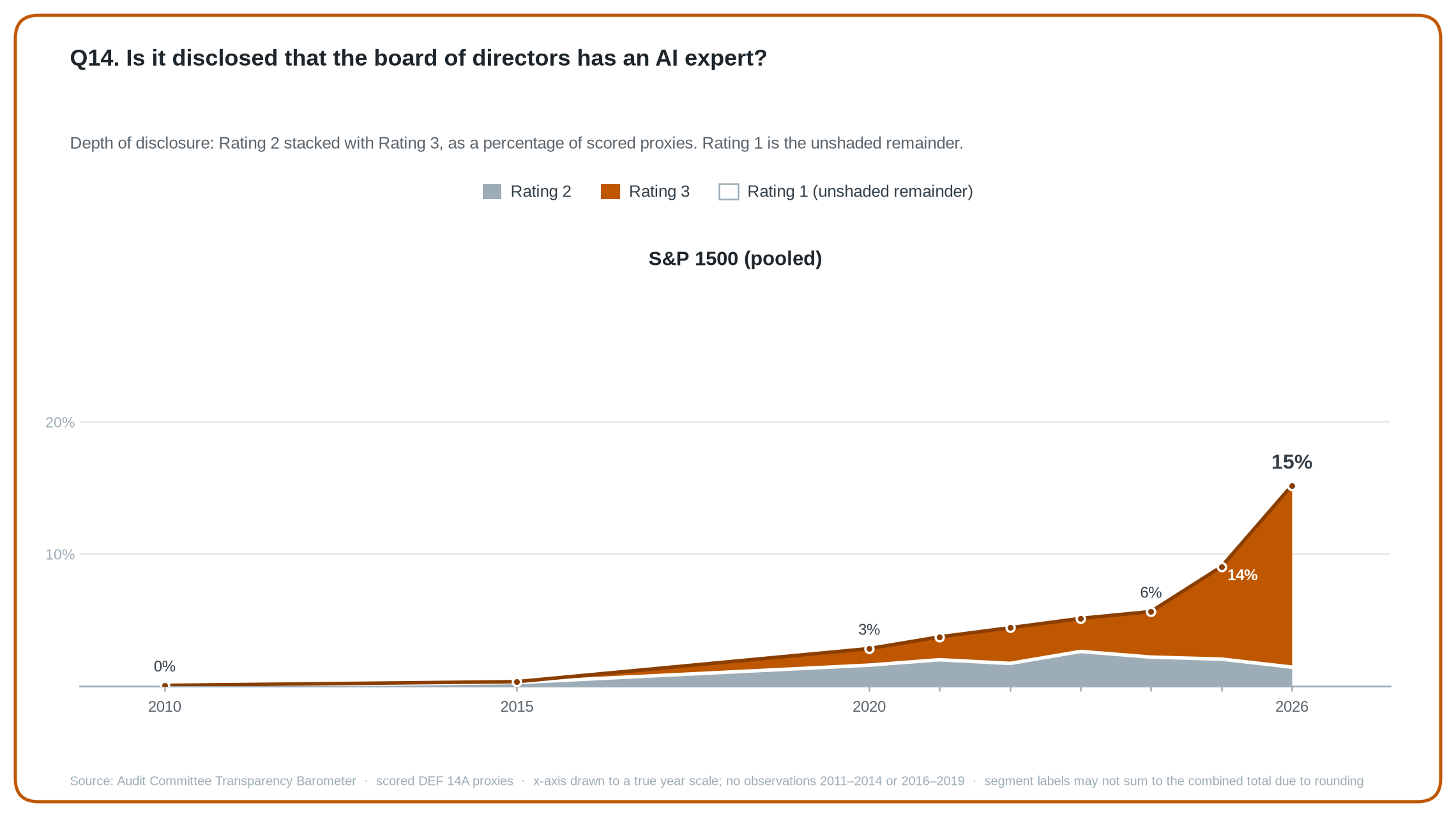
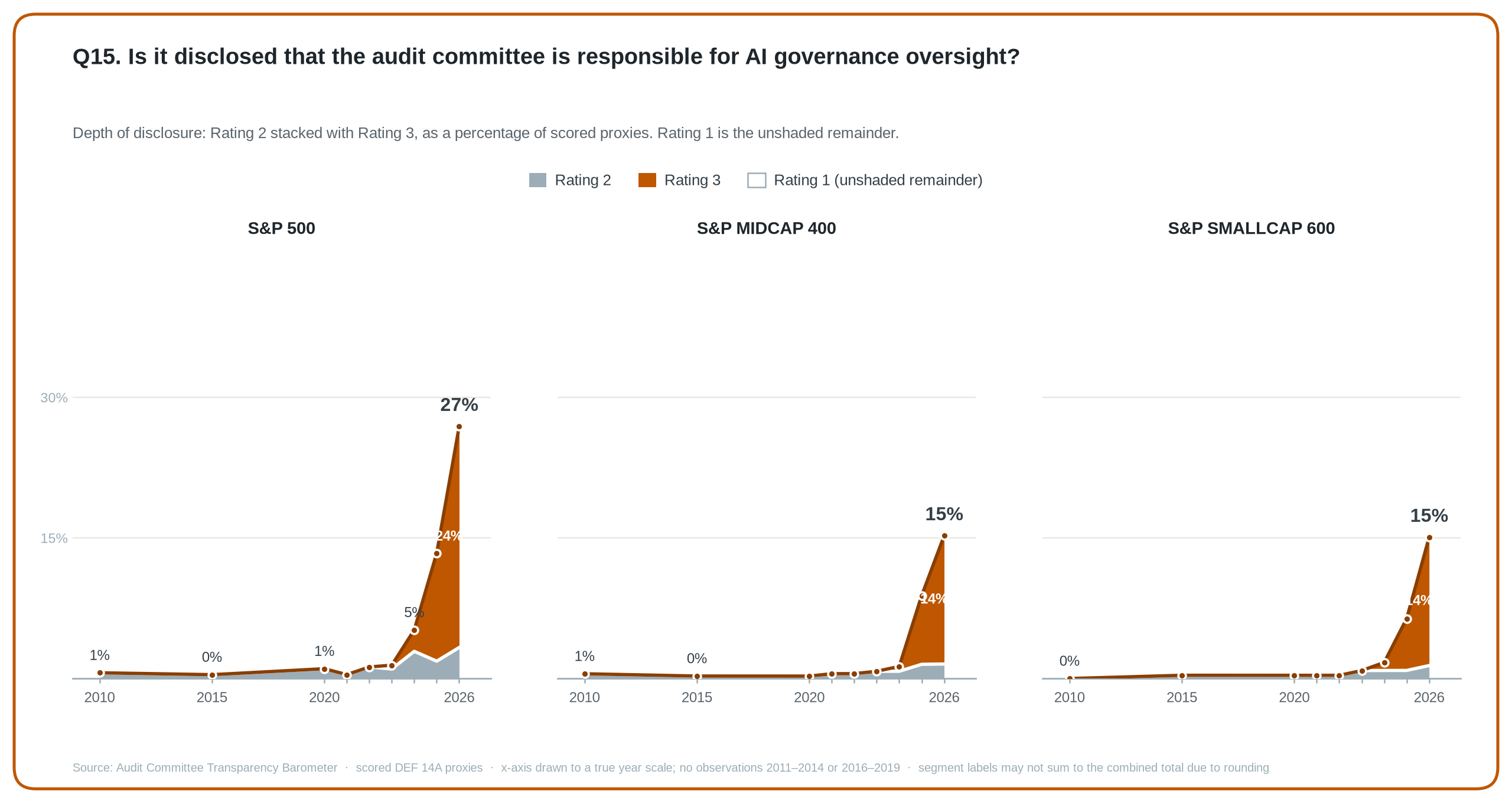
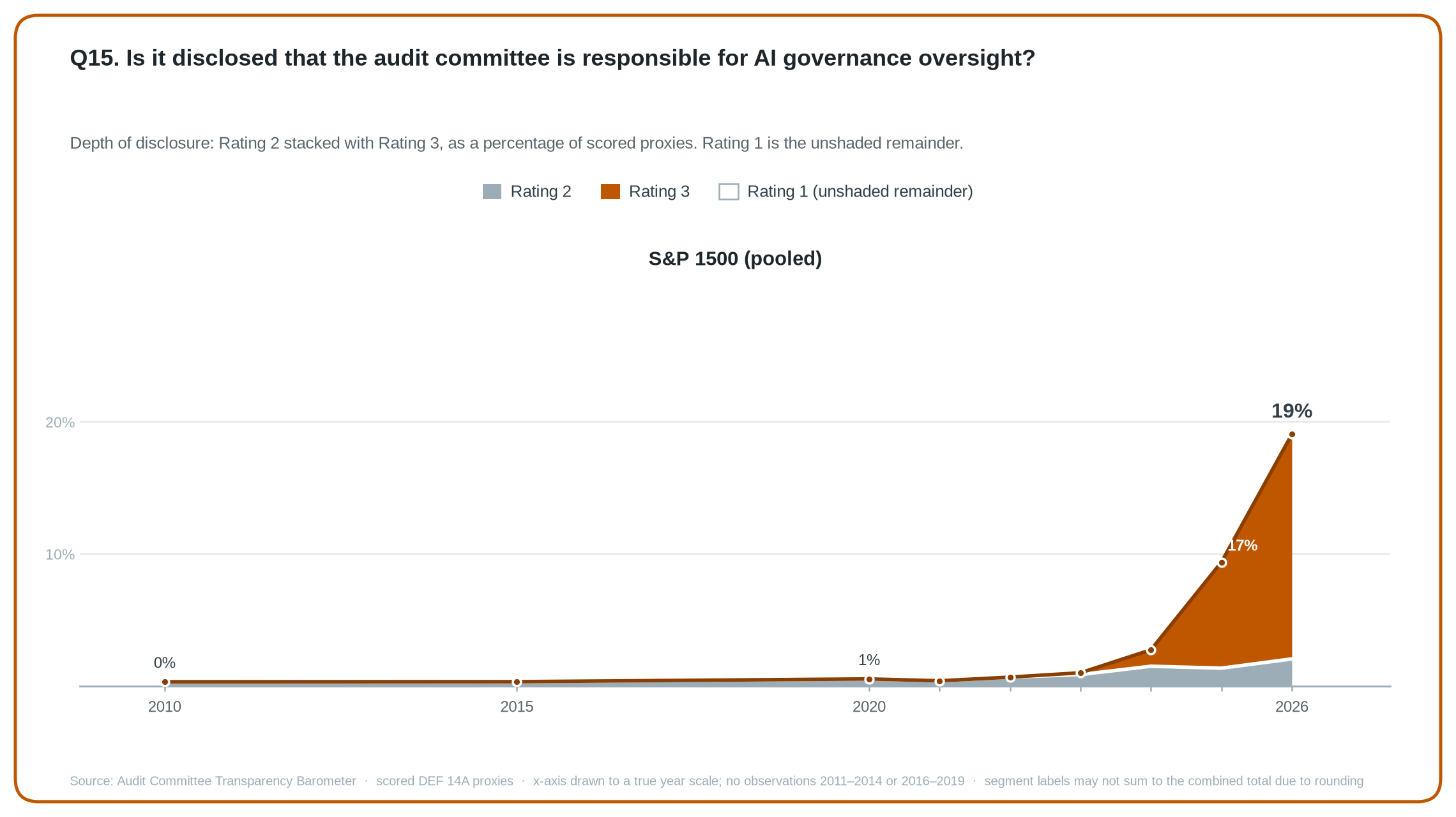
How S&P 1500 audit committees describe their work in the annual proxy statement, measured on 13 three-tier questions across 2010, 2015 and 2020–2026. Each question below gives its full wording, the Rating 1, 2 and 3 criteria, the trend by index, and the locked 2026 exemplars quoted from the filings.
13
questions, each rated 1 to 3
9
proxy seasons: 2010, 2015, 2020–2026
1,447
S&P 1500 proxies scored for 2026
60
locked 2026 exemplars (32 at Rating 3)
Reading the ratings. Every scored proxy receives one of three ratings per question against a fixed written criterion. Rating 1 is the baseline (no disclosure, or a bare statement), Rating 2 is partial disclosure and Rating 3 is full disclosure on the question's own terms. The exact criteria differ by question and are quoted verbatim in each block. Ratings measure disclosure, not underlying practice.
Reading the charts. Each chart stacks the share of scored proxies at Rating 2 (gold) with Rating 3 (navy); the unshaded remainder is Rating 1. Switch between the three indexes and the pooled S&P 1500. Years are drawn to a true scale.
Question 1 of 13
Q1 Audit Committee Considerations in Appointing/Retaining the Auditor
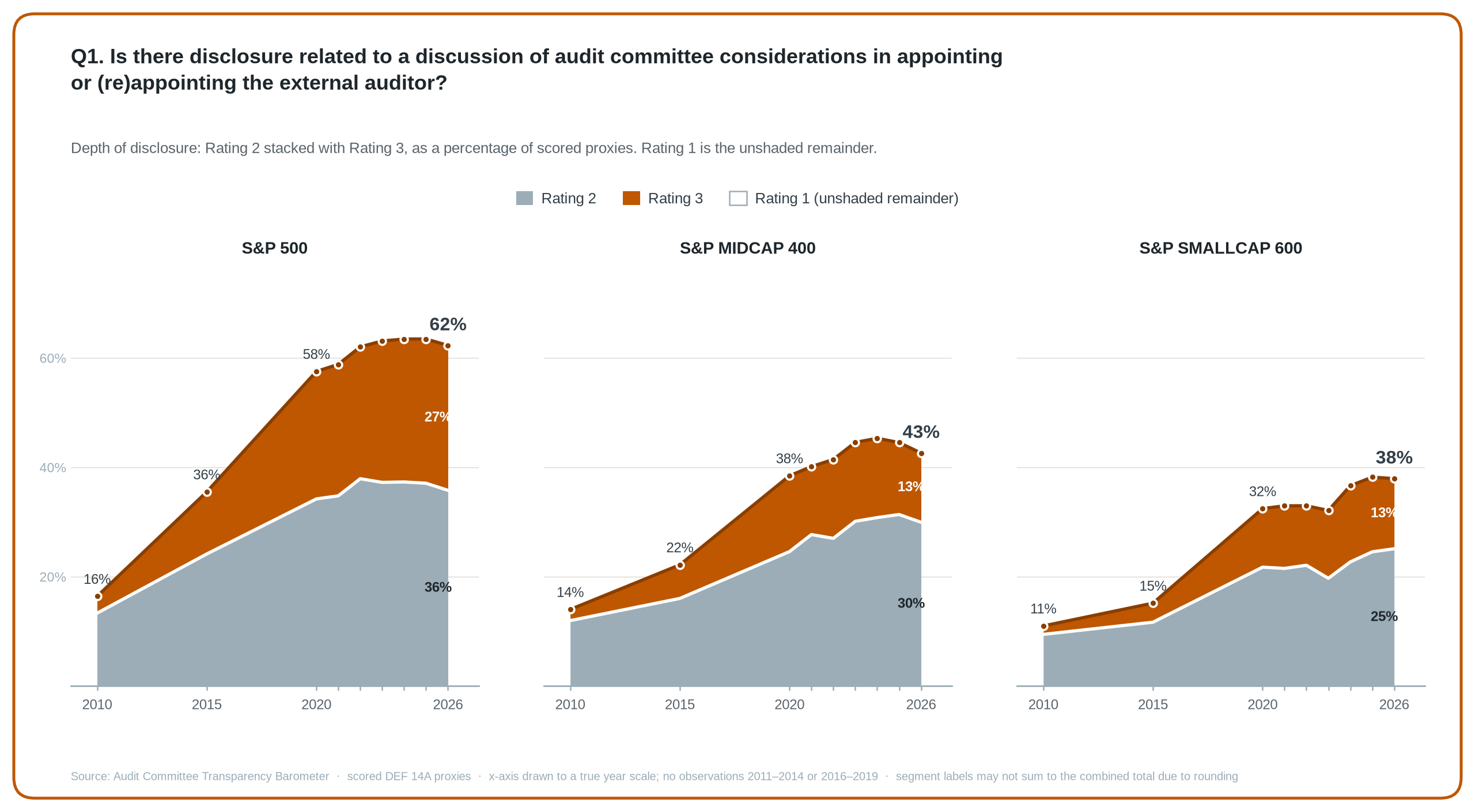
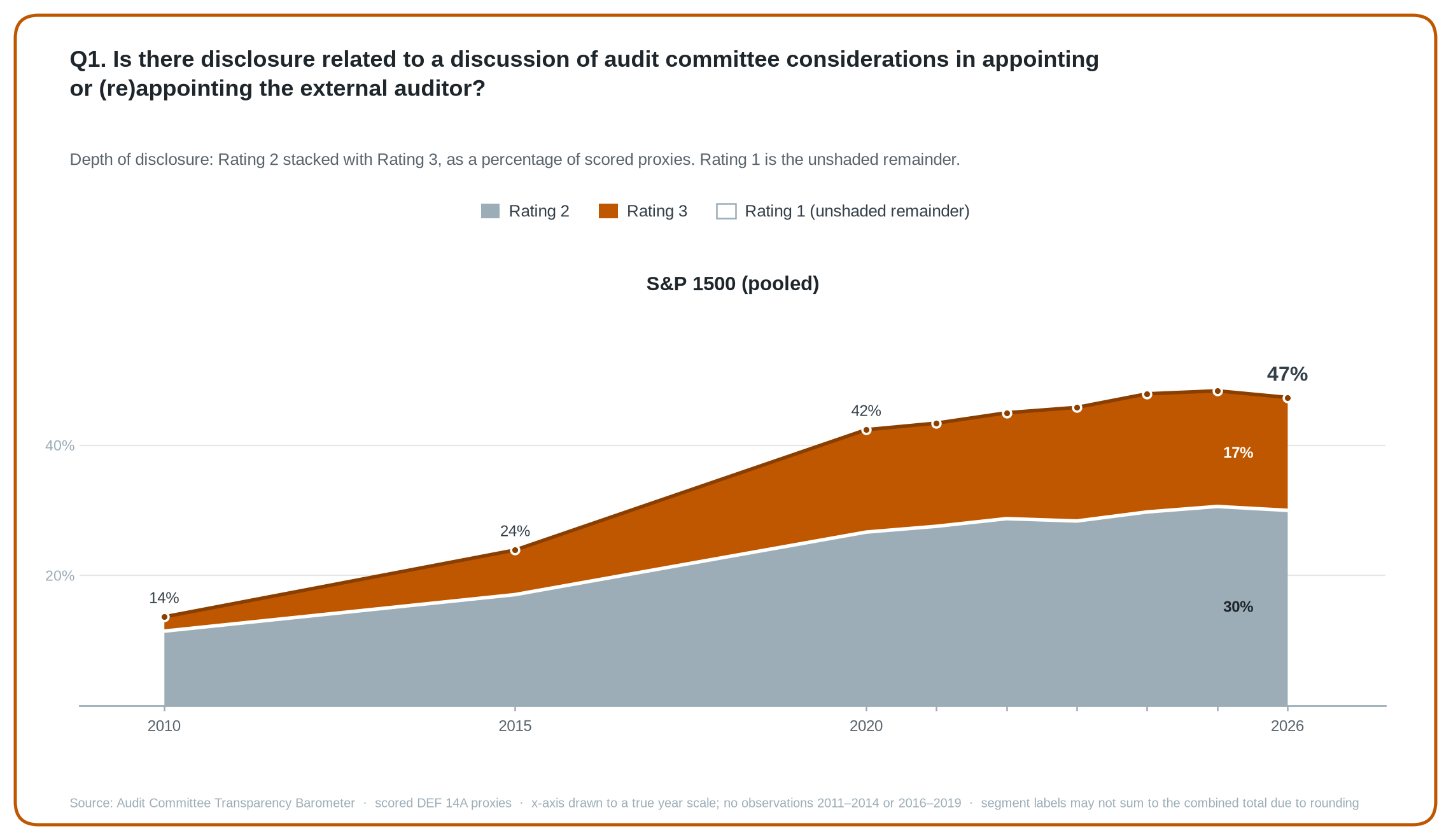
Is there disclosure related to a discussion of audit committee considerations in appointing or (re)appointing the external auditor?
Construct. How specifically does the proxy describe the evaluation work the committee performed when deciding to appoint or retain the external auditor?
Rating criteria
Rating 1 Baseline
Only states the appointment fact, describes oversight responsibilities, or contains no appointment discussion.
Rating 2 Partial
Says the committee evaluated the auditor or considered factors, including named factor categories such as expertise, performance, independence, resources, reputation, tenure, or communication quality, but does not say what concrete evaluation activity the committee performed.
Rating 3 Full
Names at least one concrete evaluation activity tied to the appointment/retention decision: reviews PCAOB inspection or quality-control reports, interviews or meets with people, obtains survey or structured feedback, makes calls, compares peer data, or performs comparable named evaluation work.
Change over time
Share at Rating 2 and Rating 3, 2010–2026
Rating 2 (gold) stacked with Rating 3 (navy) as a share of scored proxies; Rating 1 is the unshaded remainder. No observations 2011–2014 or 2016–2019.Download PNGUnderlying shares by index, 2010 and 2026
Index
2010 · Rating 2 or 3
2026 · Rating 2 or 3
Change
2026 · Rating 2
2026 · Rating 3
2026 proxies
S&P 500
16%
62%
+46 pts
36%
27%
483
S&P MidCap 400
14%
43%
+29 pts
30%
13%
387
S&P SmallCap 600
11%
38%
+27 pts
25%
13%
577
S&P 1500
14%
47%
+34 pts
30%
17%
1,447
Share of scored DEF 14A proxies. “Rating 2 or 3” combines the two shaded tiers in the chart. Change is in percentage points, 2010 to 2026.
2026 exemplars 4 locked
Locked examples of strong disclosure from the 2026 proxy season. Evidence text is the coded reading of the filing, including the passages it quotes; the location points to where the disclosure appears. Rating 3 examples come first.
PDF page 103, Item 3. Ratification of KPMG LLP - Background
Evidence
The disclosure satisfies Rating 3 by naming multiple concrete evaluation activities performed in connection with the auditor review and retention decision, including a structured survey and peer fee comparisons. The proxy states: "To assist the Audit Committee with its review, management prepares an annual assessment of KPMG that includes (1) an analysis of KPMG’s known legal risks and significant proceedings that may impair KPMG’s ability to perform BNY’s annual audit, (2) the results of a survey of management and Audit Committee members regarding KPMG’s overall performance and (3) KPMG’s fees and services compared to services provided by KPMG and other auditing firms to peer companies."
Why this example
Names a structured survey of management and committee members plus peer fee benchmarking, showing non-PCAOB evaluation work also earns Rating 3.
Original coding rationale
Clear and concise illustration of Rating 3 evaluation activities, explicitly naming a structured performance survey of management and committee members along with peer fee and service benchmarking.
PDF page 57, Proposal 2 – Ratify the Appointment of BDO USA, P.C. as our Independent Registered Public Accounting Firm for 2026
Evidence
The disclosure satisfies Rating 3 by naming multiple concrete evaluation activities performed by the Audit Committee in deciding to retain the auditor. On PDF page 57 (Proposal 2), the proxy states: "To address these concerns, the Audit Committee: ... conducts a quarterly assessment of BDO’s service quality, and its working relationship with our management; conducts regular private meetings separately with each of BDO and our management; interviews and approves the selection of BDO’s new lead engagement partner with each rotation; at least annually, obtains and reviews a report from BDO, describing all relationships between the independent auditor and Hecla; and reviews data relating to audit quality and performance, including the most recent Public Company Accounting Oversight Board (“PCAOB”) reports on BDO and its peer firms."
Why this example
Rich MidCap example: interviews the incoming engagement partner, holds private meetings, quarterly assessments, and reviews PCAOB reports.
Original coding rationale
Provides a clear and comprehensive list of concrete auditor evaluation activities (PCAOB reports, quarterly assessments, partner interviews, independence reviews) in the retention context.
page 65, Proposal No. 2 - Ratification of Appointment of Independent Registered Public Accounting Firm
Evidence
The proxy states that the audit committee evaluated the independent auditor for re-appointment and lists factor categories considered, but does not identify any concrete evaluation activities (such as surveys, PCAOB inspection report reviews, interviews, or peer comparisons). Under Proposal No. 2 (page 65), the filing states: "In making the determination to re-appoint Ernst & Young for 2026, the Audit Committee considered, among other factors, the independence and performance of Ernst & Young, and the quality and candor of Ernst & Young’s communications with the Audit Committee and management." This satisfies the Rating 2 criterion of naming factor categories without describing concrete evaluation activities.
Why this example
Canonical minimal Rating 2: names independence, performance, and communication quality as reappointment factors in one sentence, with no evaluation activity described.
Original coding rationale
This is a classic, representative example of Rating 2 factor-category disclosure that lacks concrete evaluation activities.
The Audit Committee Report lists specific factor categories evaluated when deciding whether to reappoint the auditor, but does not identify any concrete evaluation activity (such as structured surveys, PCAOB inspection report reviews, or interviews). The proxy states: "In determining whether to reappoint Ernst & Young as Envista's independent auditor, the Audit Committee took into consideration a number of factors, including the firm's tenure, independence, global capability and expertise and performance."
Why this example
Compact Audit Committee Report sentence naming tenure, independence, global capability, expertise, performance; clean factor-category-only language for MidCap coders.
Original coding rationale
Clear and concise illustration of Rating 2 factor listing in reappointment deliberations without named evaluation procedures.
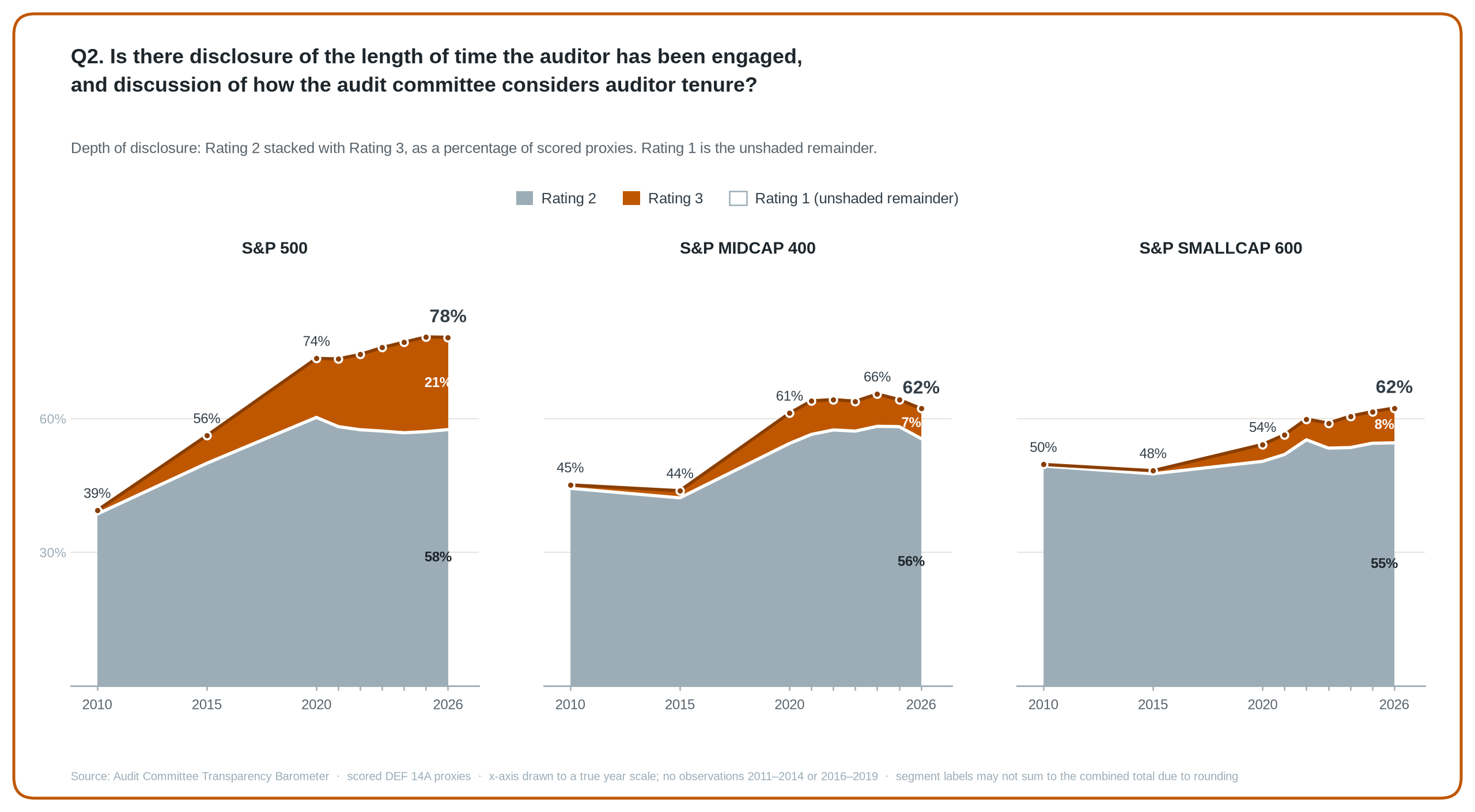
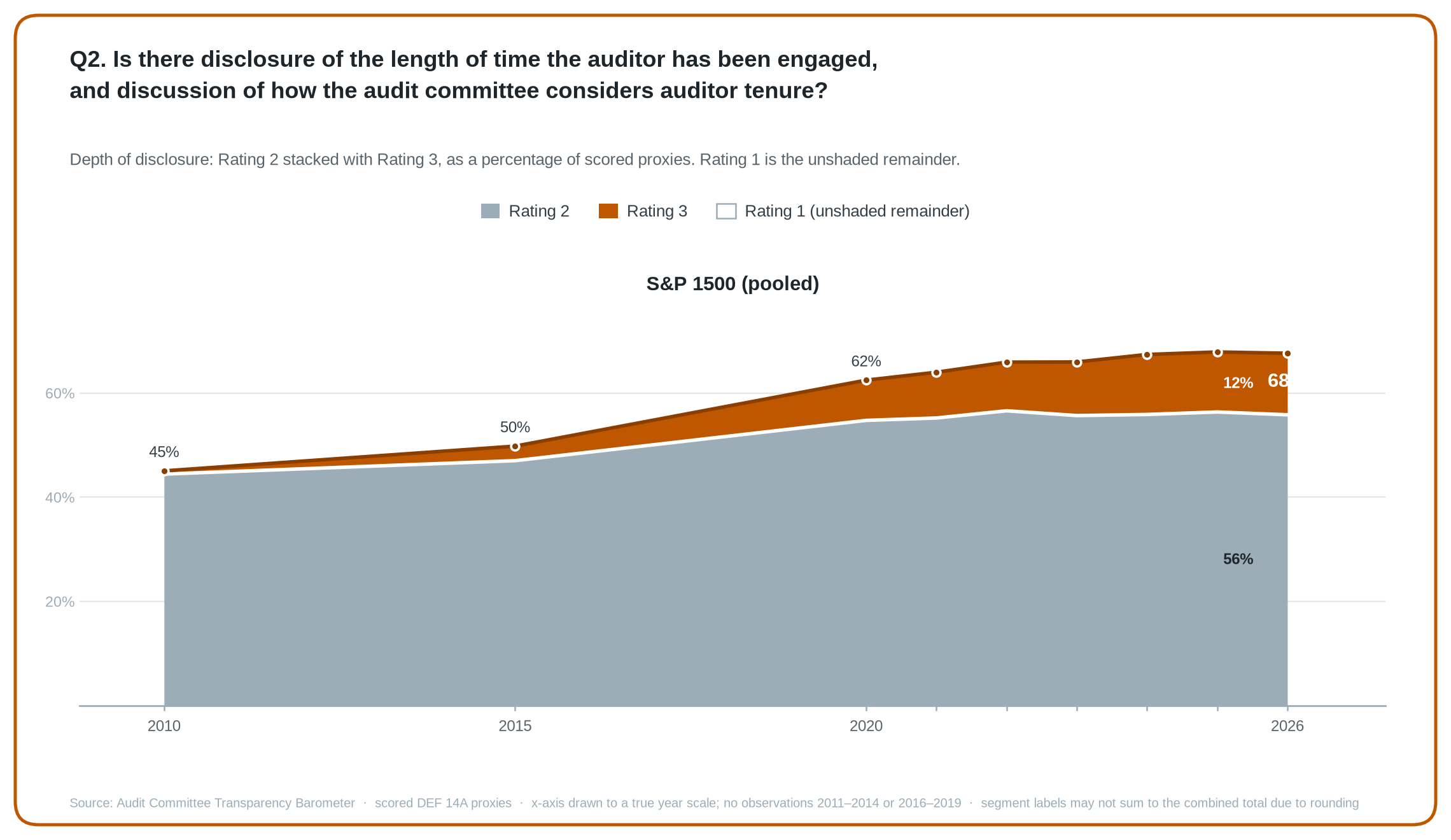
Is there disclosure of the length of time the auditor has been engaged, and discussion of how the audit committee considers auditor tenure?
Construct. How completely does the proxy disclose the length of the auditor relationship and explain a tenure-related benefit, risk, safeguard, or rationale?
Rating criteria
Rating 1 Baseline
No tenure disclosure, or only a bare adjective such as "long-standing auditor" without quantification or meaningful tenure substance.
Rating 2 Partial
Provides meaningful partial disclosure but lacks one of those two elements: substantive tenure discussion without the explicit start year, OR a start year or exact duration without a named tenure-related benefit, risk, safeguard, or rationale.
Rating 3 Full
Gives the explicit calendar or fiscal year when the auditor relationship began AND names a tenure-related benefit, risk, safeguard, or rationale.
In the v30 instrument this question absorbs the earlier sub-question Q2_1.
Change over time
Share at Rating 2 and Rating 3, 2010–2026
Rating 2 (gold) stacked with Rating 3 (navy) as a share of scored proxies; Rating 1 is the unshaded remainder. No observations 2011–2014 or 2016–2019.Download PNGUnderlying shares by index, 2010 and 2026
Index
2010 · Rating 2 or 3
2026 · Rating 2 or 3
Change
2026 · Rating 2
2026 · Rating 3
2026 proxies
S&P 500
39%
78%
+39 pts
58%
21%
483
S&P MidCap 400
45%
62%
+17 pts
56%
7%
387
S&P SmallCap 600
50%
62%
+13 pts
55%
8%
577
S&P 1500
45%
68%
+23 pts
56%
12%
1,447
Share of scored DEF 14A proxies. “Rating 2 or 3” combines the two shaded tiers in the chart. Change is in percentage points, 2010 to 2026.
2026 exemplars 5 locked
Locked examples of strong disclosure from the 2026 proxy season. Evidence text is the coded reading of the filing, including the passages it quotes; the location points to where the disclosure appears. Rating 3 examples come first.
The three Rating 3 examples are shown with the coded evidence from the 2026 production reading of each filing, marked accordingly.
page 67, Proposal No. 3 - We Engaged KPMG After a Rigorous Review Process
Evidence
The disclosure satisfies both prongs of Rating 3: (1) it explicitly discloses the start year: "KPMG has served as the Company’s independent registered public accounting firm continuously since 1993" (page 67), and (2) it provides an extensive discussion of tenure-related benefits, risks, and safeguards, stating: "The Audit Committee believes that, if handled properly, there are numerous benefits of a long-term independent auditor relationship, including: Higher Audit Quality: Through 33 years of experience with the Company KPMG has gained institutional knowledge of and deep expertise regarding our operations and primary business segments, accounting policies and practices and internal controls over financial reporting; Efficient Fee Structure: KPMG’s aggregate fees are competitive with peer companies because of KPMG’s familiarity with the Company and industry expertise; and Avoidance of Disruption: Onboarding a new independent auditor requires a significant time and cost commitment that could distract from management’s and the Audit Committee’s focus on financial reporting and internal controls." It also explicitly identifies independence risk and safeguards ("The Company and the Audit Committee are also aware that a long-tenured auditor may be believed by some to pose an independence risk. To address these concerns, there are safeguards for auditor independence...").
PDF page 74, PROPOSAL 2 – RATIFICATION OF SELECTION OF INDEPENDENT REGISTERED PUBLIC ACCOUNTANT
Evidence
The proxy explicitly states the start year of KPMG's service and discusses specific tenure-related benefits and safeguards on page 74: "KPMG LLP has served as our Company’s independent registered public accountants since 1989. In order to assure continuing auditor independence, the audit committee periodically considers whether the annual audit of the Company’s financial statements should be conducted by another firm. With respect to the length of KPMG LLP’s tenure, we believe this enhances our audit quality due to their significant institutional knowledge and deep expertise of our Company’s global business, accounting policies and practices, and internal controls over financial reporting. In addition, as a result of their familiarity with our Company, audit and other fees remain competitive, and we avoid the costs and disruptions associated with bringing on a new independent auditor. Furthermore, the lead audit partner on the Company’s engagement serves no more than five consecutive years in that role, in accordance with SEC rules." This satisfies both prongs of Rating 3: explicit start year (1989) and substantive discussion connecting tenure to audit quality, institutional knowledge, fee competitiveness, avoided onboarding costs, and rotation safeguards.
Page 129, Proposal 3 - Ratification of Appointment of Independent Registered Public Accounting Firm for 2026
Evidence
The proxy discloses the explicit start year of the relationship ('PwC, or its predecessor firm, has served as our independent registered public accounting firm continuously since 1985.') and explicitly details tenure-related benefits (audit efficiency from deep understanding, efficient fee structures from familiarity, and avoidance of significant costs and disruptions from onboarding a new auditor), tenure-related risks (independence risk), and specific safeguards (regulatory framework, partner rotation, annual assessment, private executive sessions). This satisfies both prongs of Rating 3.
Page 30, Proposal 3: Ratification of the Selection of the Independent Registered Public Accounting Firm for Fiscal 2027 (PDF page 58)
Evidence
The proxy explicitly quantifies auditor tenure by specifying the starting fiscal year of the relationship, but it does not provide any tenure-related rationale, benefit, risk, or safeguard. Proposal 3 on page 30 (PDF page 58) states: "EY has served as Brown-Forman’s independent registered public accounting firm since fiscal 2021. The members of the Audit Committee believe that retaining EY to serve as the independent registered public accounting firm is in the best interests of Brown-Forman and its stockholders." Under the Q2 codebook rule, providing an explicit start year without an accompanying substantive discussion of tenure-related effects or rationale meets the threshold for Rating 2.
Why this example
States "EY has served since fiscal 2021," then only a generic best-interests sentence; explicit start year with no named tenure benefit, risk, or safeguard. | contrast: Clean R2 pole: quantification without rationale. Adding any institutional-knowledge or fee-efficiency benefit would make it R3.
Original coding rationale
Clear and concise example of Rating 2 disclosure providing the exact start year ("since fiscal 2021") followed immediately by a generic best interests statement with no discussion of tenure-related benefits or risks.
PDF page 101, Section: 'PROPOSALS TO BE VOTED ON AT THE ANNUAL MEETING - VOTING ITEM 2—RATIFICATION OF THE APPOINTMENT OF INDEPENDENT AUDITOR'
Evidence
The proxy discusses the benefits and safeguards associated with auditor tenure but omits an explicit start year: "PricewaterhouseCoopers LLP has been retained as our external auditor continuously for many years. During its tenure as the external auditor, the firm has maintained its independence and regularly rotated the audit partner as required by the SEC and PCAOB. Through its external audit work the firm has gained valuable institutional knowledge enabling effective audit practices and procedures." Under the Q2 codebook rule, substantive tenure discussion (naming institutional knowledge, audit practices, and independence safeguards) without an explicit calendar or fiscal start year qualifies for Rating 2.
Why this example
Names institutional knowledge, effective audit practices, and partner-rotation safeguards, but says only "continuously for many years" with no start year. | contrast: Mirror image of the other R2s: full tenure substance, missing year. Contrast with R1's identical vagueness but zero substance.
Original coding rationale
Clear illustration of Rating 2 where substantive tenure benefits (institutional knowledge, effective audit practices) and safeguards (partner rotation) are articulated, but the start year is omitted ('for many years').
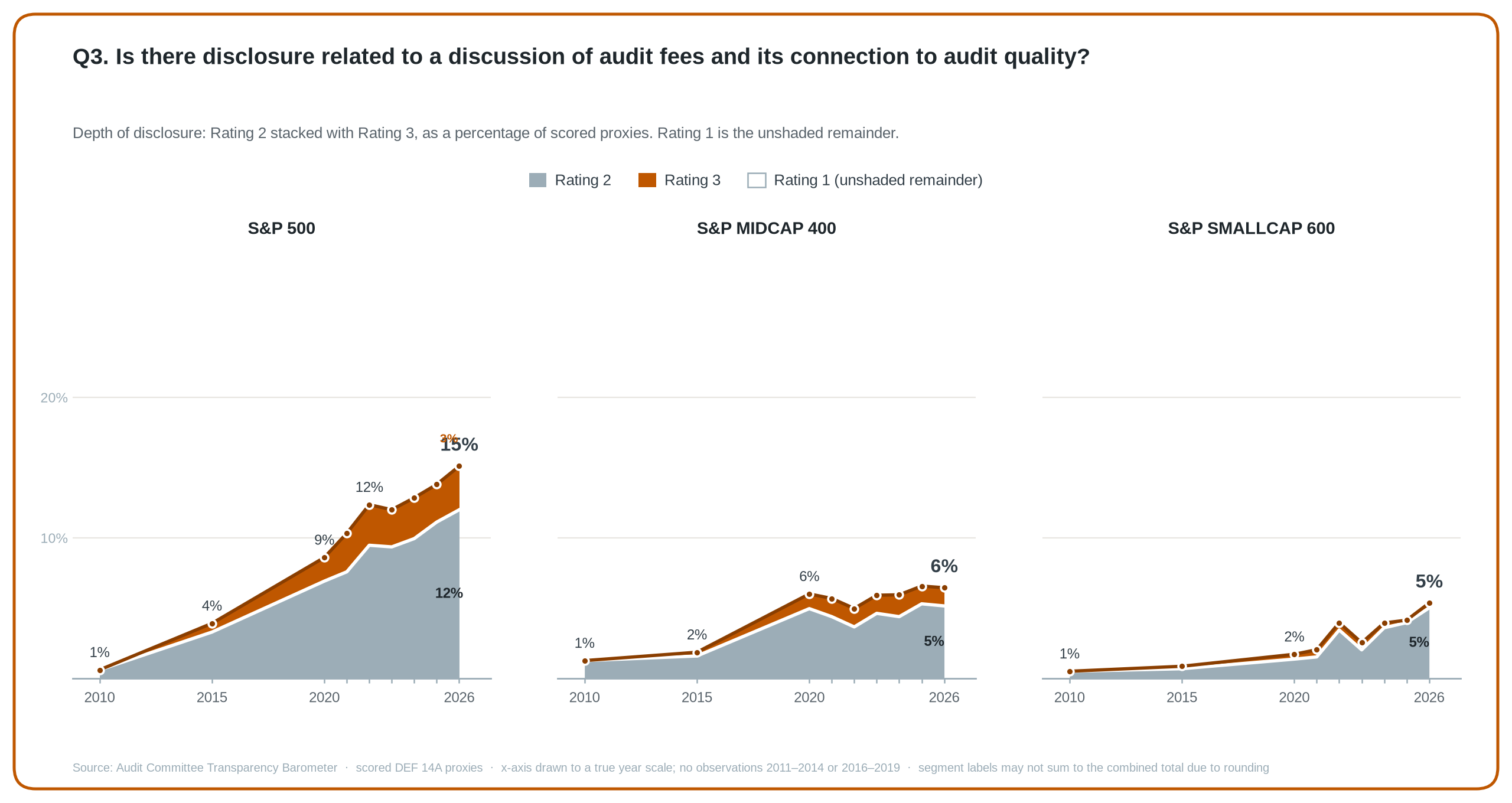
Is there disclosure related to a discussion of audit fees and its connection to audit quality?
Construct. Does the proxy explicitly connect audit fee levels to audit quality?
Rating criteria
Rating 1 Baseline
Fee tables, descriptions, or approval processes with no quality reference.
Rating 2 Partial
Discusses fees and quality in proximity but without an explicit link.
Rating 3 Full
Explicitly links fees to quality: "fees are appropriate to ensure a quality audit," "fee levels reflect the scope and quality of services."
Change over time
Share at Rating 2 and Rating 3, 2010–2026
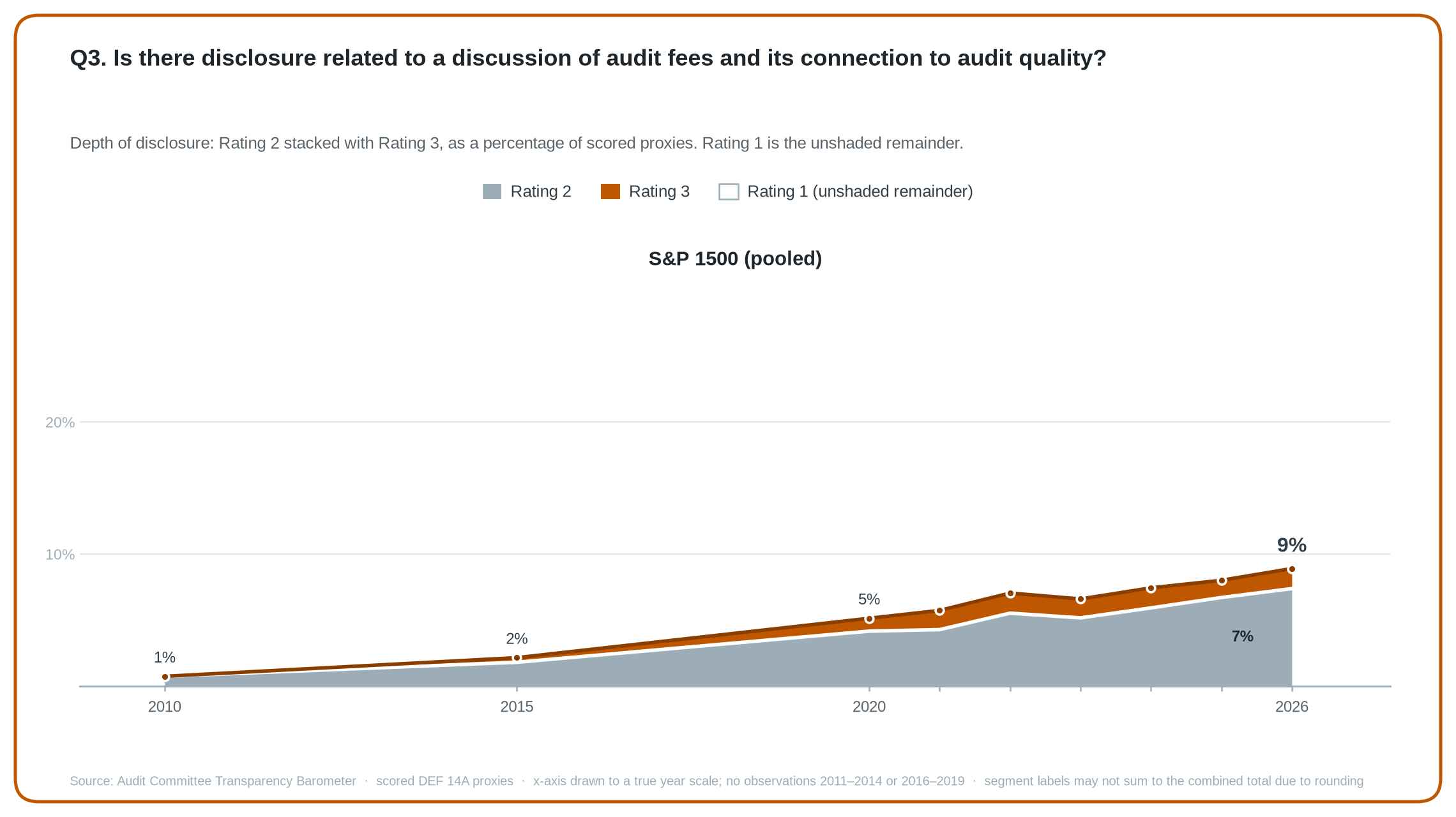
Rating 2 (gold) stacked with Rating 3 (navy) as a share of scored proxies; Rating 1 is the unshaded remainder. No observations 2011–2014 or 2016–2019.Download PNGUnderlying shares by index, 2010 and 2026
Index
2010 · Rating 2 or 3
2026 · Rating 2 or 3
Change
2026 · Rating 2
2026 · Rating 3
2026 proxies
S&P 500
1%
15%
+14 pts
12%
3%
483
S&P MidCap 400
1%
6%
+5 pts
5%
1%
387
S&P SmallCap 600
1%
5%
+5 pts
5%
0%
577
S&P 1500
1%
9%
+8 pts
7%
2%
1,447
Share of scored DEF 14A proxies. “Rating 2 or 3” combines the two shaded tiers in the chart. Change is in percentage points, 2010 to 2026.
2026 exemplars 5 locked
Locked examples of strong disclosure from the 2026 proxy season. Evidence text is the coded reading of the filing, including the passages it quotes; the location points to where the disclosure appears. Rating 3 examples come first.
PDF page 121; Proposal Three: Ratification of Appointment of Independent Registered Public Accounting Firm - Evaluation of Independent Registered Public Accounting Firm
Evidence
In Proposal Three, under the Audit Committee's annual evaluation factors for reappointing Ernst & Young LLP, the proxy explicitly links fees to audit quality and efficiency: 'The appropriateness of the independent auditor’s fees relative to the quality and efficiency of audit services provided.' This directly connects fee levels to audit quality and efficiency, meeting the Rating 3 criterion ('fee levels reflect the scope and quality of services').
Why this example
Evaluation factor expressly weighs auditor fees relative to the quality and efficiency of audit services provided, the codebook's bright-line fee-to-quality formulation. | contrast: SmallCap counterpart showing concise checklist language can satisfy R3 where Welltower's list does not.
Original coding rationale
Concise and direct example of linking fee appropriateness explicitly to audit quality and efficiency within evaluation considerations.
PDF page 65, Proposal 3 – Ratification of Appointment of Independent Registered Public Accounting Firm
Evidence
The proxy satisfies Rating 3 by explicitly connecting audit fee levels to audit quality within the committee's evaluation criteria. Proposal 3 states that the Audit Committee considered: "● The appropriateness of the firm’s fees relative to both efficiency and audit quality;" (PDF page 65). This explicitly links fee appropriateness directly to audit quality, satisfying the codebook standard that fee levels be evaluated relative to audit quality.
Why this example
Committee considers the appropriateness of fees relative to both efficiency and audit quality, explicitly measuring fee levels against quality of services. | contrast: The word 'relative to' is what lifts this above Welltower's parallel list of fee and quality items.
Original coding rationale
Provides a concise and direct example of Rating 3 where the proxy explicitly evaluates fee appropriateness relative to audit quality in the auditor retention factors.
PDF page 88, Proposal No. 3: Ratification of Appointment of Independent Auditor
Evidence
Proposal 3 discusses audit quality and fees in the same sentence: "EY has developed significant expertise and experience with our business, accounting policies and practices and our internal control over financial reporting, which we believe allows for a higher quality audit and a competitive fee structure." Because audit quality and fee structure are discussed in direct proximity as co-benefits of auditor familiarity, but without an explicit causal link stating that the fee level itself causes or is necessary to ensure audit quality, this meets the criterion for Rating 2.
Why this example
Tenure-based expertise is said to allow both a higher quality audit and a competitive fee structure, making them coordinate benefits rather than linked quantities. | contrast: Contrasts with R3 tenure language where efficiency 'results in' the fee structure; here both merely coexist.
Original coding rationale
Excellent illustration of Rating 2 proximity where audit quality and competitive fee structure are coordinate benefits of auditor tenure without a direct causal link between fees and quality.
The disclosure meets Rating 2 because the proxy discusses audit fees and audit quality in close proximity within the fee deliberation process, but does not state an explicit causal link that fee levels cause or determine audit quality. The proxy states: "The Committee's deliberations consider balancing the design of an audit scope that will achieve a high-quality audit that drive efficiencies from both the Company and PwC while compensating PwC fairly."
Why this example
Scope deliberation balances achieving a high-quality audit with compensating the auditor fairly; quality and pay are adjacent objectives, not an asserted fee-quality relationship. | contrast: Shows proximity inside one sentence still falls short of R3 absent a stated causal or relative link.
Original coding rationale
Demonstrates the subtle boundary for Rating 2 where audit quality and auditor compensation are discussed in the same sentence regarding scope balancing, but lack a direct causal claim that fee levels drive quality.
PDF page 40, Proposal 2 – Ratification of the Selection of the Independent Registered Public Accounting Firm (Audit Fees, page 30)
Evidence
The proxy mentions fees and audit quality in direct proximity within the same sentence outlining committee considerations: 'The Audit Committee considers whether the independent registered public accounting firm is best positioned and qualified to provide the most effective and efficient service based on factors such as the independent registered public accounting firm\'s familiarity with Welltower\'s business, personnel, culture, accounting systems, and risk profile; the appropriateness of fees charged; and whether provision of the service by the independent registered public accounting firm would enhance Welltower\'s ability to manage or control risk or improve audit quality.' Because 'appropriateness of fees charged' and 'improve audit quality' are discussed in proximity as separate items in a list of considerations rather than establishing an explicit causal connection where fee levels drive audit quality, it satisfies the criteria for Rating 2.
Why this example
Fee appropriateness and improving audit quality appear as separate bullet-style items in one list of retention considerations, with no stated connection between fee level and quality. | contrast: Near-miss on R3: same list format as Victoria's Secret and Matson, but fees and quality stay parallel rather than relative.
Original coding rationale
Clearly illustrates the Rating 2 threshold where fee appropriateness and audit quality appear in direct proximity in a list of retention considerations without an explicit causal link.
The ideal disclosure here makes it clear that the audit committee has considered whether the auditor has the resources/fees required to staff the audit appropriately and deliver a high quality audit. Acknowledging the tradeoff (e.g., long tenure helps increase quality while reducing fees) is enough for R2 but not R3.
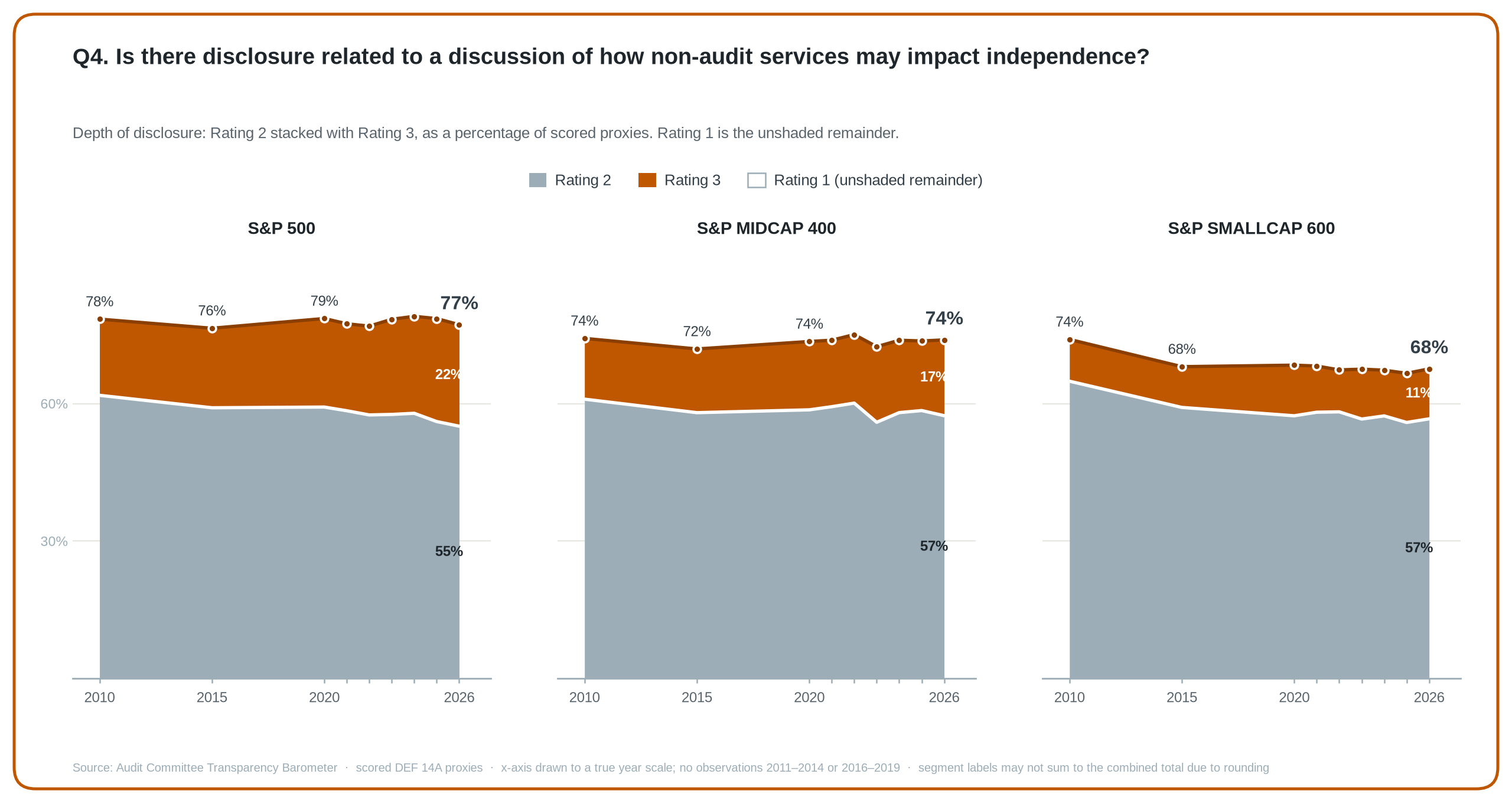
Is there disclosure related to a discussion of how non-audit services may impact independence?
Construct. Does the proxy describe how the audit committee considers the impact of non-audit services (NAS) on auditor independence?
Rating criteria
Rating 1 Baseline
The proxy does not connect NAS to independence in the audit committee's voice. A pre-approval policy by itself, the standard AC Report PCAOB independence-letter language by itself, and the two together without a sentence that links NAS specifically to the committee's independence judgment all belong here.
Rating 2 Partial
The audit committee makes an explicit conclusory statement that connects NAS to independence — e.g., "the Audit Committee determined that non-audit services are compatible with maintaining the auditor's independence" — but does NOT describe how the committee reached that conclusion.
Rating 3 Full
The audit committee describes HOW it evaluates NAS for independence. Naming specific factors the committee considered, monitoring activities it performs, criteria or tests it applies, or services it prohibits all qualify.
Change over time
Share at Rating 2 and Rating 3, 2010–2026
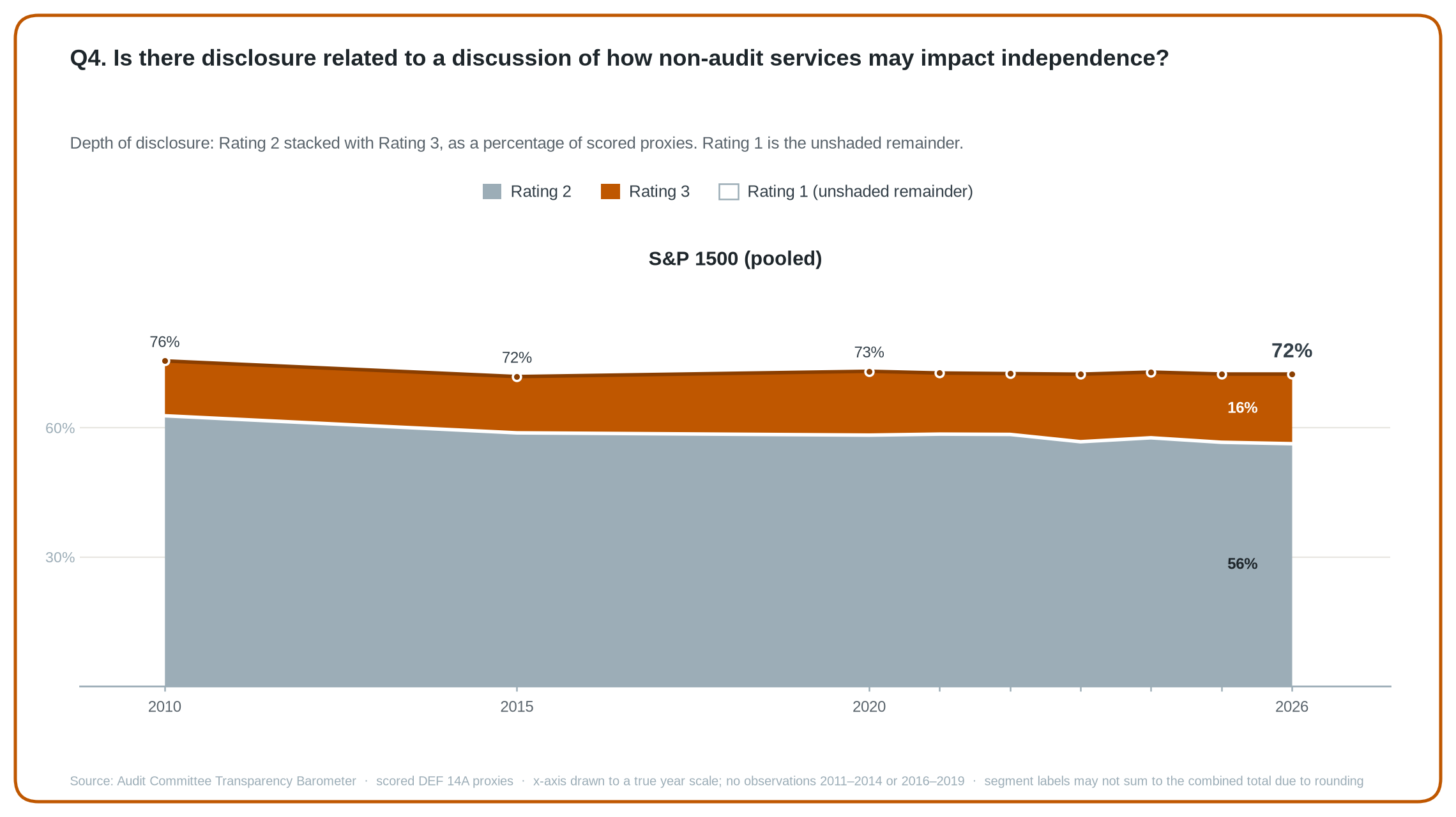
Rating 2 (gold) stacked with Rating 3 (navy) as a share of scored proxies; Rating 1 is the unshaded remainder. No observations 2011–2014 or 2016–2019.Download PNGUnderlying shares by index, 2010 and 2026
Index
2010 · Rating 2 or 3
2026 · Rating 2 or 3
Change
2026 · Rating 2
2026 · Rating 3
2026 proxies
S&P 500
78%
77%
−1 pts
55%
22%
483
S&P MidCap 400
74%
74%
+0 pts
57%
17%
387
S&P SmallCap 600
74%
68%
−6 pts
57%
11%
577
S&P 1500
76%
72%
−3 pts
56%
16%
1,447
Share of scored DEF 14A proxies. “Rating 2 or 3” combines the two shaded tiers in the chart. Change is in percentage points, 2010 to 2026.
2026 exemplars 5 locked
Locked examples of strong disclosure from the 2026 proxy season. Evidence text is the coded reading of the filing, including the passages it quotes; the location points to where the disclosure appears. Rating 3 examples come first.
Item 2: Proposal to Ratify the Selection of Ernst & Young LLP as the Company's Independent Registered Public Accounting Firm for 2026 - Policy for Approval of Audit and Permitted Non-Audit Services, page 38 (PDF page 45)
Evidence
The proxy describes an active monitoring activity performed by the Audit Committee to safeguard auditor independence regarding non-audit services. On page 38 (PDF page 45): "These services are actively monitored (both spending and work content) by the Audit Committee to maintain the appropriate objectivity and independence in EY's core work, which is the annual audit of the Company's consolidated financial statements and internal control over financial reporting. The Audit Committee determined that all services provided by EY in 2025 were permissible under applicable independence rules." This ongoing monitoring of spending and work content satisfies Rating 3.
Why this example
Committee 'actively monitored (both spending and work content)' non-audit services to maintain objectivity and independence in EY's core audit work. | contrast: Monitoring activity path to R3: describes ongoing committee conduct, not just a conclusion.
Original coding rationale
Matches the codebook's canonical Rating 3 monitoring exemplar almost verbatim, clearly demonstrating how an ongoing monitoring process moves a non-audit services disclosure beyond a conclusory statement.
PDF page 75, Pre-Approval of Audit and Non-Audit Services
Evidence
The proxy details specific tests and criteria the Audit Committee must apply when evaluating non-audit services for independence, as well as a specific safeguard prohibiting approval if independence is impaired. Under 'Pre-Approval of Audit and Non-Audit Services': "Under our policy and procedures, when considering whether to approve non-audit services to be provided by our independent accountant, the Audit Committee must consider whether the provision of the service would adversely affect the independence of the independent accountant. Specifically, the Audit Committee must consider whether the provision of the service would (i) place the accountant in the position of auditing his or her own work; (ii) result in the accountant acting as management or an employee of the Company; or (iii) place the accountant in the position of being an advocate for us. Any proposed non-audit service that the Audit Committee determines would adversely affect the independence of our independent accountant will not be approved."
Why this example
Committee must test whether a service makes the accountant audit its own work, act as management, or become an advocate, and must reject impairing services. | contrast: Criteria/tests path to R3, contrasting with R1 policies that merely list prohibited services.
Original coding rationale
Exemplary illustration of Rating 3 specifying three concrete independence tests (self-audit, management role, advocacy) and a mandatory refusal safeguard.
PDF page 114, Proposal 3 – Independent Registered Public Accounting Firm Fees
Evidence
The proxy includes an explicit conclusory statement by the Audit Committee connecting non-audit services to auditor independence, but does not describe the specific evaluation process, criteria, monitoring activities, or tests applied. On PDF page 114, under Independent Registered Public Accounting Firm Fees, the proxy states: "The Audit Committee has considered whether the provision of non-audit services is compatible with maintaining the independence of Deloitte and has concluded that it is." Under codebook rules, an explicit conclusory determination linking NAS to independence without describing how the committee evaluated or monitored the impact meets the exact criterion for Rating 2.
Why this example
Canonical conclusory statement: the committee 'has considered whether the provision of non-audit services is compatible with maintaining the independence of Deloitte and has concluded that it is.' | contrast: Textbook R2 anchor: explicit NAS-independence conclusion with zero description of how it was reached.
Original coding rationale
Contains the canonical verbatim conclusory NAS independence compatibility statement ('has considered whether the provision of non-audit services is compatible with maintaining the independence of Deloitte and has concluded that it is') perfectly illustrating Rating 2.
page 93 (PDF page 122), PROXY ITEM NO. 2: RATIFICATION OF APPOINTMENT OF INDEPENDENT REGISTERED PUBLIC ACCOUNTANTS
Evidence
The proxy contains an explicit conclusory statement by the audit committee connecting non-audit services to auditor independence without detailing specific evaluative tests or monitoring frameworks. On page 93 (PDF page 122), under Proposal 2, the proxy states: "The Audit and Finance Committee reviewed summaries of the services provided by Deloitte and the related fees and determined that the provision of non-audit services is compatible with maintaining the independence of Deloitte." Under the Q4 codebook, an explicit conclusory determination linking non-audit services to independence without describing how the committee reached that conclusion meets the criterion for Rating 2.
Why this example
Committee reviewed summaries of Deloitte services and related fees and determined non-audit services compatible with independence, but names no criteria, tests, or monitoring. | contrast: Boundary toward R3: reviewing fee summaries is an input, not a disclosed evaluation standard.
Original coding rationale
Provides a clear and representative illustration of Rating 2: an explicit conclusory statement that the provision of non-audit services is compatible with maintaining auditor independence, following a review of fee summaries, but without detailed evaluative tests or monitoring mechanisms.
PDF page 41, Proposal Two: Ratification of Appointment of Independent Registered Public Accounting Firm — Independent Registered Public Accounting Firm Fees and Services
Evidence
The Audit Committee provides an explicit conclusory determination linking non-audit services to independence without describing the evaluation process or criteria used: "In addition to performing the audit of our consolidated financial statements, KPMG LLP provided various other services during the fiscal year ended September 27, 2025. Our Audit Committee has determined that KPMG LLP’s provision of these services, which are described below, does not impair KPMG LLP’s independence from us." (PDF page 41). Under the codebook, an explicit conclusory statement in the committee's voice that NAS does not impair independence without explaining how the committee evaluated NAS is Rating 2.
Why this example
Single explicit determination that KPMG's provision of the listed other services 'does not impair KPMG's independence,' with no evaluative process described. | contrast: Shows R2 needs only one committee-voice conclusion, distinguishing it from R1's purpose clauses.
Original coding rationale
This is an exceptionally clean, textbook example of Rating 2: a single explicit sentence stating the Audit Committee's determination that non-audit services do not impair independence, unaccompanied by any discussion of the evaluation process or specific independence tests.
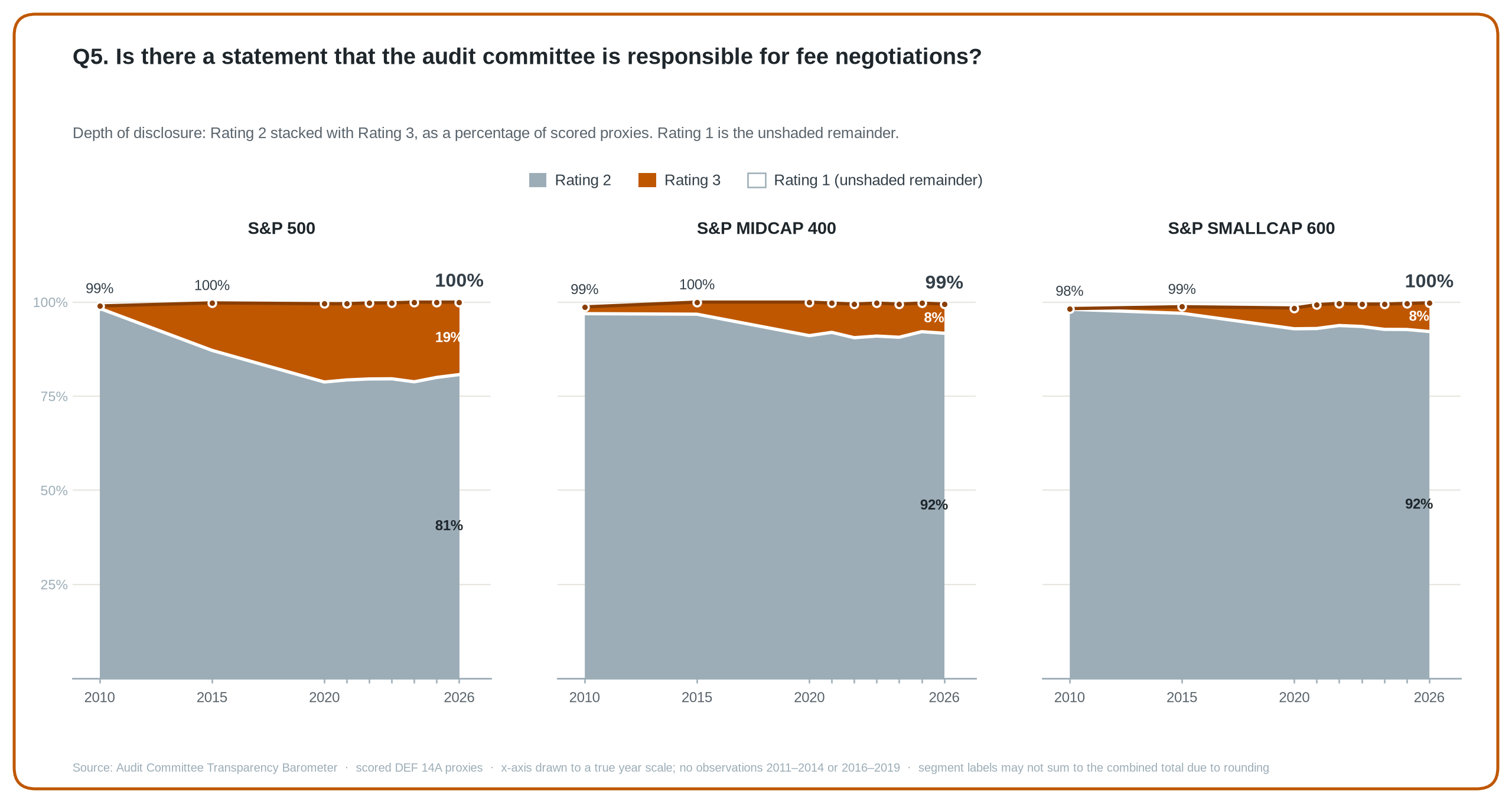
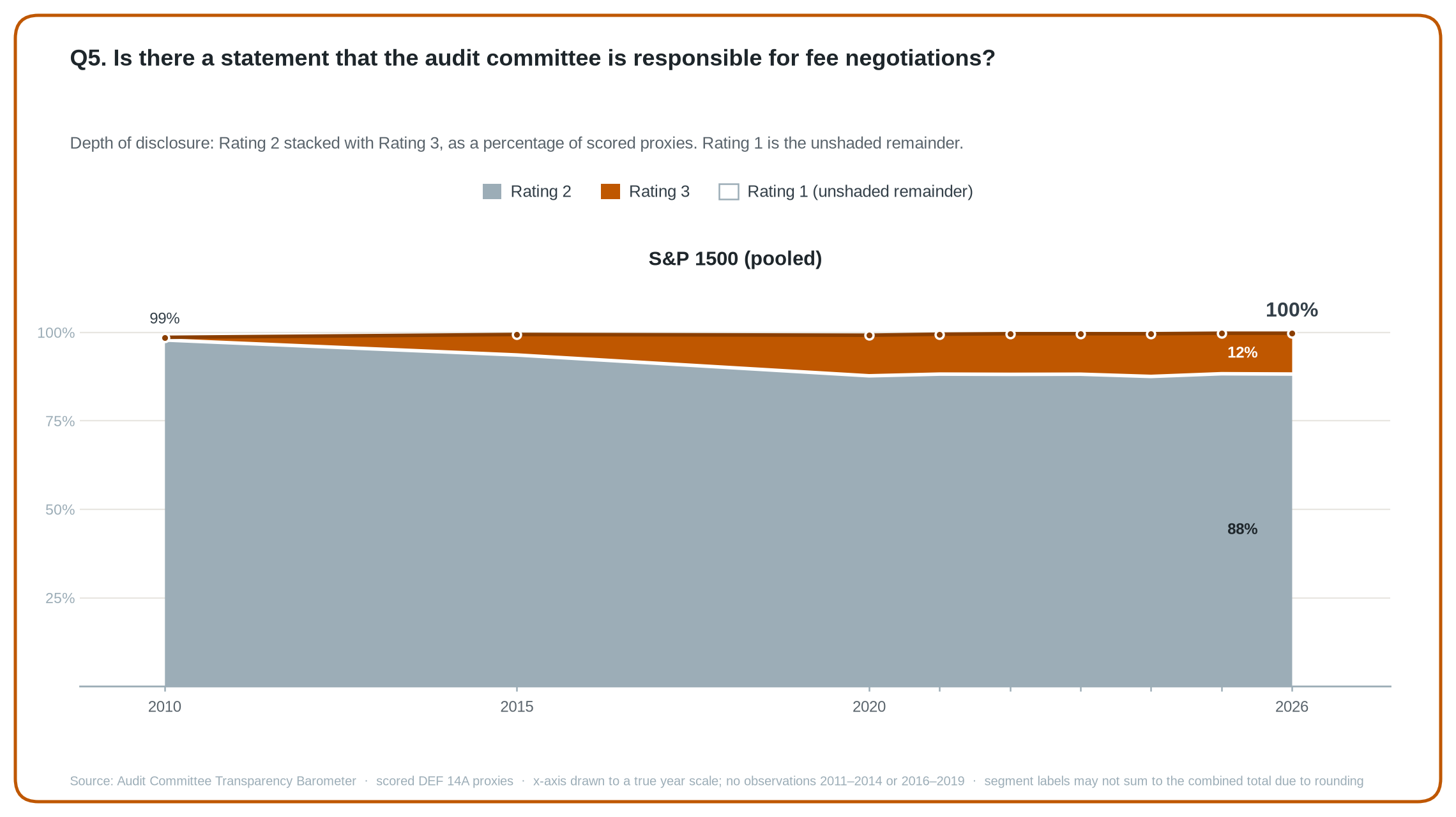
Q5 Audit Committee Involvement in Fee Determination
Is there a statement that the audit committee is responsible for fee negotiations?
Construct. Does the proxy disclose that the audit committee is substantively involved in determining audit fees — beyond merely approving a fee negotiated by others?
Rating criteria
Rating 1 Baseline
No disclosure of the committee's role in audit fees.
Rating 2 Partial
States the committee approves or pre-approves audit fees without indicating involvement in setting fee levels, OR merely recites statutory/charter authority to determine auditor remuneration.
Rating 3 Full
Discloses substantive committee involvement in fee determination: negotiates fees, discusses fee levels with the auditor, evaluates fee appropriateness against benchmarks, or otherwise indicates active participation in setting fee levels. The word "negotiate" qualifies but is not required.
Change over time
Share at Rating 2 and Rating 3, 2010–2026
Rating 2 (gold) stacked with Rating 3 (navy) as a share of scored proxies; Rating 1 is the unshaded remainder. No observations 2011–2014 or 2016–2019.Download PNGUnderlying shares by index, 2010 and 2026
Index
2010 · Rating 2 or 3
2026 · Rating 2 or 3
Change
2026 · Rating 2
2026 · Rating 3
2026 proxies
S&P 500
99%
100%
+1 pts
81%
19%
483
S&P MidCap 400
99%
99%
+1 pts
92%
8%
387
S&P SmallCap 600
98%
100%
+2 pts
92%
8%
577
S&P 1500
99%
100%
+1 pts
88%
12%
1,447
Share of scored DEF 14A proxies. “Rating 2 or 3” combines the two shaded tiers in the chart. Change is in percentage points, 2010 to 2026.
2026 exemplars 5 locked
Locked examples of strong disclosure from the 2026 proxy season. Evidence text is the coded reading of the filing, including the passages it quotes; the location points to where the disclosure appears. Rating 3 examples come first.
page 74 (PDF page 77), Audit Matters — Policy on Pre-Approval of Audit Services and Non-Audit Services
Evidence
The proxy explicitly discloses that the Audit Committee is actively involved in negotiating audit fees rather than merely approving a predetermined figure. On page 74 (PDF page 77), under 'Policy on Pre-Approval of Audit Services and Non-Audit Services', the filing states: "For audit services, our independent auditor provides an engagement letter to our Audit Committee prior to commencing its second quarter review work, which outlines the scope of the proposed audit and audit-related fees. Our Audit Committee reviews the letter and negotiates with and formally engages the auditor." Because the disclosure explicitly states that the Audit Committee reviews the engagement letter and negotiates fees with the auditor, it satisfies the bright-line criterion for Rating 3.
Why this example
Committee reviews the auditor's engagement letter outlining proposed fees and then 'negotiates with and formally engages the auditor' — direct committee fee negotiation. | contrast: Crosses the R2 line because the committee itself negotiates, rather than approving a letter management negotiated.
Original coding rationale
Direct, unambiguous statement of substantive fee involvement: 'Our Audit Committee reviews the letter and negotiates with and formally engages the auditor.'
PDF page 114, Proposal 3 (Evaluation of the Independent Registered Public Accounting Firm)
Evidence
The proxy explicitly describes substantive Audit Committee involvement in determining audit fees through peer benchmarking and evaluation of audit scope and complexity. Verbatim: "CNO undertakes an annual benchmarking of audit fees paid by our peers in the insurance industry. This data provides a reference point to the Audit Committee to judge the appropriateness of the audit fee. Additionally, the Audit Committee evaluates the scope of the audit, the complexity of the CNO environment, any history of prior issues and adjustments and the overall audit plan presented by the independent auditor in arriving at an appropriate fee." This satisfies Rating 3 by showing active committee evaluation of fee levels against peer benchmarks and operational factors rather than mere sign-off.
Why this example
Committee uses annual peer-industry fee benchmarking plus scope, complexity, and audit-plan evaluation to arrive at an appropriate fee, without using 'negotiate'. | contrast: Shows R3 is reachable via committee benchmarking and fee-setting judgment, not only negotiation language.
Original coding rationale
Excellent, concise example of Rating 3 showing substantive committee involvement in fee determination through peer benchmarking and evaluation of audit complexity, scope, and plan.
PDF page 57, Proposal 2: Ratification of the Appointment of Deloitte & Touche LLP (Audit Committee Pre-Approval Policy)
Evidence
Verbatim from PDF page 57: "The Audit Committee has adopted a Pre-Approval Policy for Audit, Audit-Related, and Non-Audit Services. The Audit Committee has delegated to the Audit Committee Chairperson the authority to pre-approve services not prohibited by law up to various maximums depending on the type of service provided, provided that the Audit Committee Chairperson shall report any decisions to pre-approve services to the full Audit Committee at its next meeting." The disclosure describes the committee's pre-approval authority and sign-off procedures without indicating active involvement in setting, negotiating, or benchmarking fee levels, which meets Rating 2.
Why this example
Pure pre-approval policy with chair delegation thresholds and reporting back; no mention of fee levels, negotiation, or benchmarking anywhere. | contrast: Baseline R2 floor: approval machinery only, contrasting with R3 cases that add fee-level participation.
Original coding rationale
This passage is a clear, textbook illustration of Rating 2 where the audit committee's pre-approval policy and chair delegation are described, but no fee-setting or negotiation activity is mentioned.
PDF page 32, Information Concerning Independent Registered Public Accountants - Negotiation of Fees Payable to the Independent Registered Public Accountants
Evidence
The proxy states on PDF page 32 under 'Negotiation of Fees Payable to the Independent Registered Public Accountants' that: "Each year, the Company’s management conducts a robust, good-faith negotiation, overseen by the Audit Committee, with the independent registered public accountant regarding the proposed fees for the engagement. This negotiation includes a review for reasonableness of fees incurred during the previous year, as well as a review for reasonableness of fees for the proposed engagement, with consideration of any enhancements to the Company’s financial and other internal controls as a result of the Company’s year-over-year growth and expansion into new international jurisdictions." Because management conducts the negotiation and the Audit Committee's role is described as oversight of that process rather than direct committee negotiation or fee-setting, this meets the criteria for Rating 2 under the conservative interpretation rule.
Why this example
Describes a robust good-faith fee negotiation with reasonableness review, but management conducts it and the committee only oversees the process. | contrast: Teaches that the word 'negotiation' alone does not earn R3 when the negotiator is management.
Original coding rationale
Helpful example of the Rating 2/Rating 3 boundary where management conducts fee negotiations under Audit Committee oversight with articulated reasonableness factors.
PDF pages 65, 75, 76, Board Committees - Audit Committee; Item 2 - Benefits of longer tenure and independence controls; Pre-Approval Processes
Evidence
The proxy describes the audit committee's formal charter authority to compensate the auditor and pre-approve fees, while disclosing that management conducts the discussions and benchmarking regarding proposed fee levels. On page 42 (PDF page 65), the proxy states: "The committee has ultimate authority and responsibility to appoint, retain, compensate, evaluate, and where appropriate, replace the external auditors." On page 49 (PDF page 76): "The audit committee is responsible for the appointment, retention, compensation and oversight of our independent registered public accounting firm. The audit committee has adopted policies and procedures for pre-approving all services..." Meanwhile, on page 48 (PDF page 75), the proxy discloses: "Management meets with Ernst & Young to discuss proposed audit fees, including impacts from proposed changes to the scope of the engagement and from rate increases. Management also considers benchmarking data for our peer companies as well as for public companies in general." Reciting statutory/charter authority and approval processes without indicating direct committee participation in negotiating or setting fee levels satisfies the criteria for Rating 2.
Why this example
Charter authority to compensate the auditor plus pre-approval procedures, while the proxy explicitly places fee discussion and benchmarking with management, not the committee. | contrast: Shows the R2/R3 line: same benchmarking language earns R3 only when the committee, not management, performs it.
Original coding rationale
Excellent illustration of Rating 2 showing the bright line where the proxy discloses fee negotiation and benchmarking performed by management while the audit committee retains formal charter and pre-approval authority.
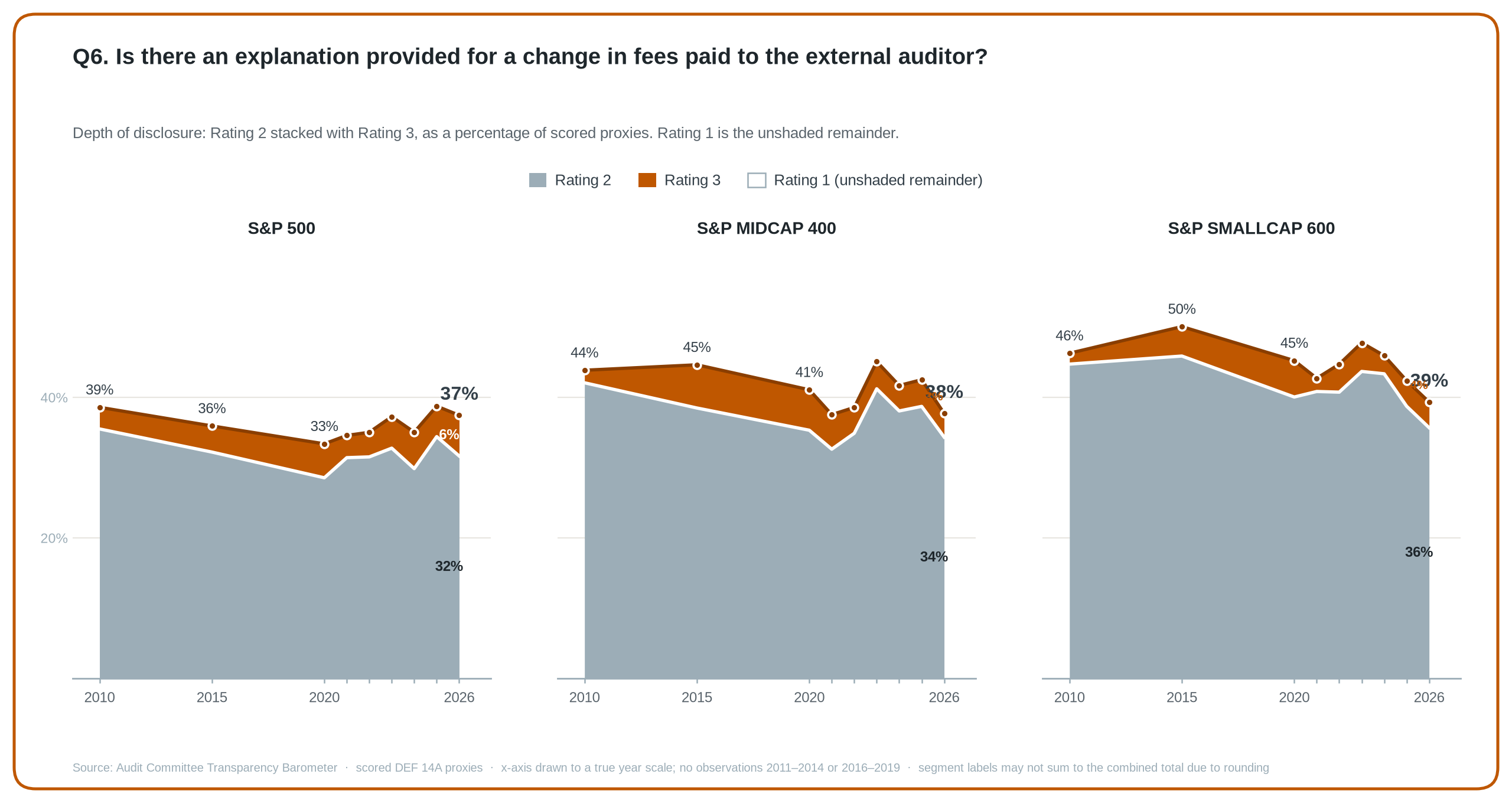
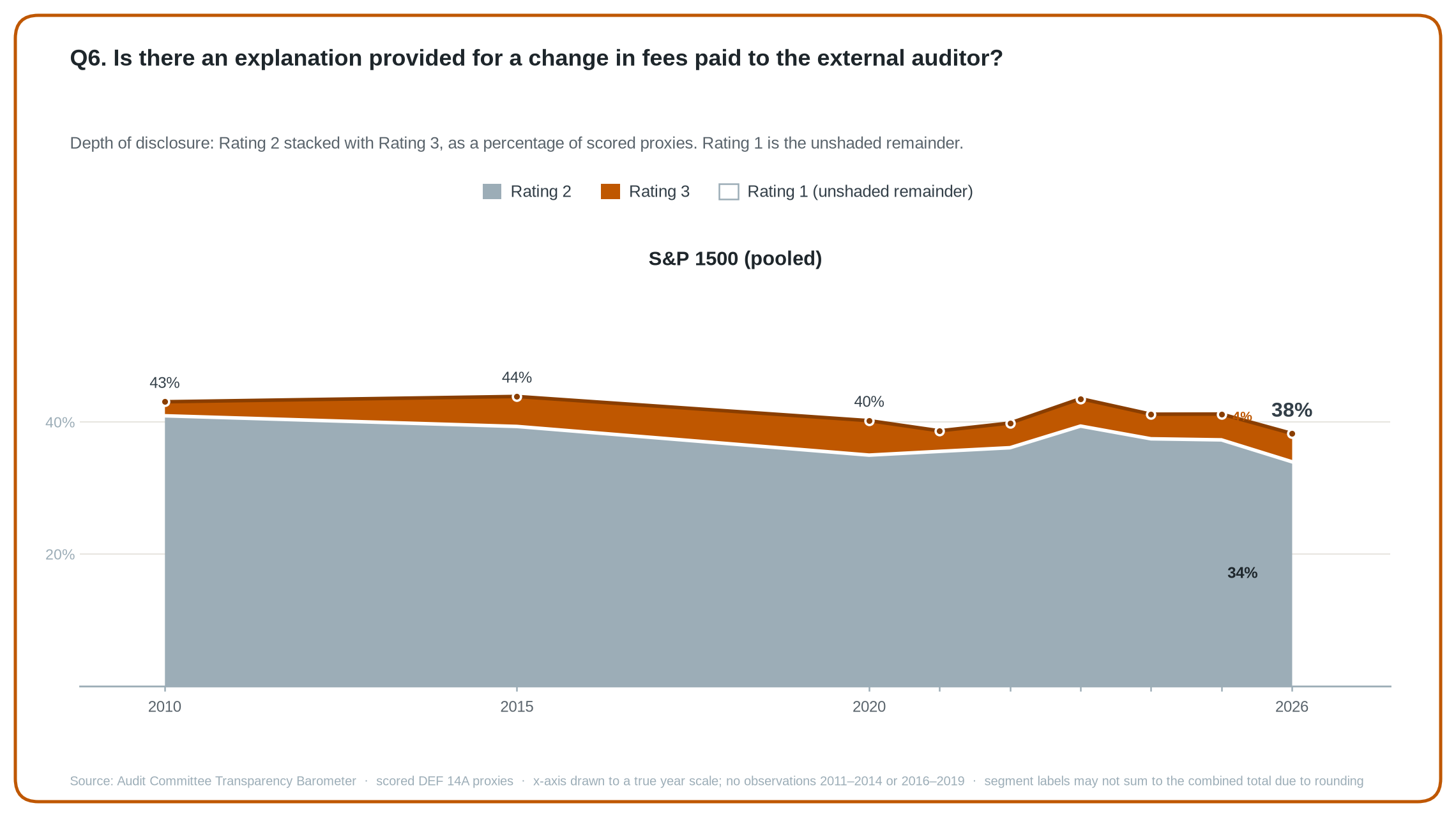
Is there an explanation provided for a change in fees paid to the external auditor?
Construct. Did total audit fees change materially from the prior year, and if so, does the proxy explain why?
Rating criteria
Rating 1 Baseline
Total audit fees did NOT change more than 10% from the prior year. No explanation is expected.
Rating 2 Partial
Total audit fees changed more than 10% from the prior year BUT the proxy does NOT provide an explicit causal explanation for the change. Fee descriptions, category definitions, and lists of services covered do NOT count as explanations.
Rating 3 Full
Total audit fees changed more than 10% from the prior year AND the proxy provides an explicit reason with causal language: "fees increased due to the acquisition of XYZ," "audit fees were higher reflecting increased complexity from the merger," "fees decreased following the divestiture of the XYZ segment."
Change over time
Share at Rating 2 and Rating 3, 2010–2026
Rating 2 (gold) stacked with Rating 3 (navy) as a share of scored proxies; Rating 1 is the unshaded remainder. No observations 2011–2014 or 2016–2019.Download PNGUnderlying shares by index, 2010 and 2026
Index
2010 · Rating 2 or 3
2026 · Rating 2 or 3
Change
2026 · Rating 2
2026 · Rating 3
2026 proxies
S&P 500
39%
37%
−1 pts
32%
6%
483
S&P MidCap 400
44%
38%
−6 pts
34%
3%
387
S&P SmallCap 600
46%
39%
−7 pts
36%
4%
577
S&P 1500
43%
38%
−5 pts
34%
4%
1,447
Share of scored DEF 14A proxies. “Rating 2 or 3” combines the two shaded tiers in the chart. Change is in percentage points, 2010 to 2026.
2026 exemplars 6 locked
Locked examples of strong disclosure from the 2026 proxy season. Evidence text is the coded reading of the filing, including the passages it quotes; the location points to where the disclosure appears. Rating 3 examples come first.
PDF page 50, Service Fees Paid to the Independent Registered Public Accounting Firm
Evidence
On PDF page 50, the fee table shows 'Audit Fees' of $4,554 thousand for fiscal year 2026 compared to $5,372 thousand for fiscal year 2025, which is a decrease of $818 thousand or 15.23% (exceeding the 10% materiality threshold). In the fee table description column, the proxy provides an explicit causal explanation for the change: 'The decrease in audit fees for fiscal year 2026 is primarily attributable to integration and divestiture activities in fiscal year 2025 that were non-recurring in fiscal year 2026.' This satisfies the Rating 3 criteria of a material fee change (>10%) accompanied by an explicit reason with causal language.
Why this example
Audit fees fell 15.23% and the proxy attributes the decrease to prior-year integration and divestiture activities that were non-recurring. | contrast: Demonstrates R3 applies to decreases, and that explaining a prior-year driver counts.
Original coding rationale
Provides a perfect example of Rating 3 for fee change explanation, explicitly calculating a >10% decrease (-15.2%) and providing direct causal attribution to non-recurring prior-year M&A integration/divestiture activities.
PDF page 35, Section III. Ratification of Appointment of Independent Registered Public Accountants (Proposal 2), table footnote (a)
Evidence
In the fee table on page 28 (PDF page 35), top-line Audit Fees increased from $3,800,000 in 2024 to $5,895,000 in 2025, representing an increase of $2,095,000 (+55.13%), which strictly exceeds the 10% materiality threshold. Footnote (a) to the table provides an explicit causal explanation for this change: "The increase in audit fees for 2025 as compared to 2024 is primarily driven by audits of the carve-out financial statements of the Company's small cells and fiber solutions businesses in connection with the Company's pending sale of its small cells and fiber solutions businesses." This satisfies all requirements for Rating 3.
Why this example
Audit fees rose 55.13% with a footnote stating the increase was 'primarily driven by' carve-out audits for the pending small cells and fiber sale. | contrast: Footnote placement still qualifies; it is causal attribution, not a list of covered services.
Original coding rationale
Provides a clear, textbook illustration of Rating 3 for Q6 where audit fees increased by more than 10% (+55.1%) and the footnote directly attributes the increase to a specific business event ("primarily driven by audits of the carve-out financial statements... in connection with the Company's pending sale...").
PDF page 55, Proposal 2 (Ratification of Appointment of Independent Auditors - Principal Accounting Fees and Services)
Evidence
Audit Fees changed by +110.3% from fiscal 2024 ($790,929) to fiscal 2025 ($1,663,452), exceeding the 10% materiality threshold. The proxy explicitly provides a causal explanation directly attributing the increase to an acquisition and integration on page 55: "Audit fees increased on a year-over-year basis primarily as a result of the acquisition of VOXX and integration of the same."
Why this example
Audit fees rose 110.3% and the proxy states fees increased 'primarily as a result of the acquisition of VOXX and integration of the same.' | contrast: Minimal-but-sufficient causal sentence — the exact element the R2 scope lists lack.
Original coding rationale
Clear and concise illustration of Rating 3 for Q6: audit fees increased by over 100% and the proxy explicitly connects the change to a specific business acquisition and integration in a single causal sentence.
PDF page 69, AUDIT INFORMATION - Fees Paid to Independent Registered Public Accounting Firm
Evidence
Audit Fees increased from $1,384,600 in 2024 to $1,534,890 in 2025, which represents an increase of $150,290 or +10.85% (strictly greater than the 10% materiality threshold). However, the proxy provides no causal explanation for the change, providing only the standard category definition: "professional services rendered for the audit of Sabra’s consolidated financial statements and review of the interim condensed consolidated financial statements included in quarterly filings and services that are normally provided by PwC in connection with statutory and regulatory filings or engagements". Under the codebook rules, when Audit Fees change by more than 10% and no explicit causal explanation is provided, the disclosure is rated 2.
Why this example
Audit fees rose 10.85% ($1,384,600 to $1,534,890), just over the threshold, with only a boilerplate definition of covered services. | contrast: Immediately above the R1 cutoff: materiality triggers the explanation test, which boilerplate fails.
Original coding rationale
Demonstrates a fee increase just above the 10% threshold (+10.85%) where no explanatory narrative is provided in the fee table or footnotes, correctly resulting in Rating 2.
PDF page 79, Audit and Non-Audit Fees and Independent Public Accountants
Evidence
On PDF page 79 (proxy page 57), the fee table discloses Audit Fees of $4,603,826 for fiscal 2025 compared to $1,467,010 for fiscal 2024, representing an increase of +213.8%, which strictly exceeds the 10% materiality threshold. The narrative below the table only provides a generic definition of what audit fees cover ("Audit fees include fees associated with the audit of our annual financial statements, the audit of our internal control over financial reporting...") without providing any causal explanation for why audit fees more than tripled. Under the Q6 rules, a material fee change without an explicit causal explanation is scored Rating 2.
Why this example
Audit fees tripled (+213.8%, $1,467,010 to $4,603,826) yet the proxy offers only generic definitions of what audit fees cover. | contrast: Shows even an enormous change stays at 2 when no causal reason is given.
Original coding rationale
Provides a clear illustration of a material fee increase (>200%) accompanied only by standard category definitions rather than an explicit causal explanation, cleanly satisfying Rating 2.
PDF page 72, Proxy page 66, 'Independent Registered Public Accountants'
Evidence
Audit fees changed by +35.59% (from $869,893 in 2024 to $1,179,494 in 2025), which strictly exceeds the 10% materiality threshold, but the proxy does not provide an explicit causal explanation for the increase. Footnote (1) on page 66 states: "Audit fees included fees and expenses associated with the audit of our annual financial statements, the reviews of the financial statements in our quarterly reports on Form 10-Q and regulatory and statutory filings, and reviews of purchase accounting related to the FBMS merger." Under the codebook rule, descriptive lists of services covered in the audit fee category do not count as causal explanations, requiring Rating 2.
Why this example
Audit fees rose 35.59% and the footnote lists FBMS merger purchase-accounting reviews as covered services, but never states the merger caused the increase. | contrast: Sharp R2/R3 boundary: naming a transaction in a scope list is not causal attribution.
Original coding rationale
Clearly illustrates Rating 2 for Q6 where audit fees increase materially (>10%) and the footnote describes included services (including merger purchase accounting review) but lacks explicit causal language explaining the change.
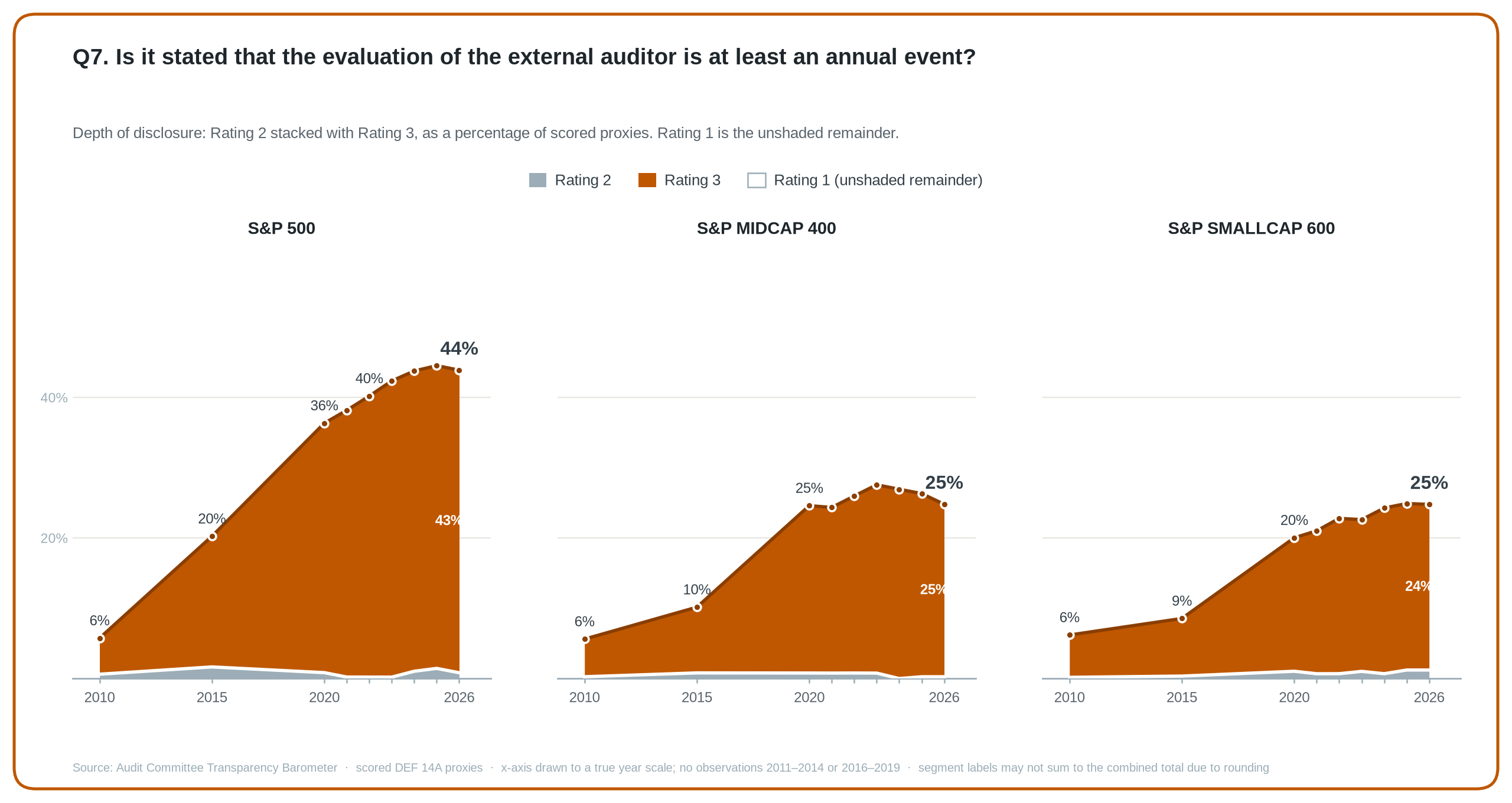
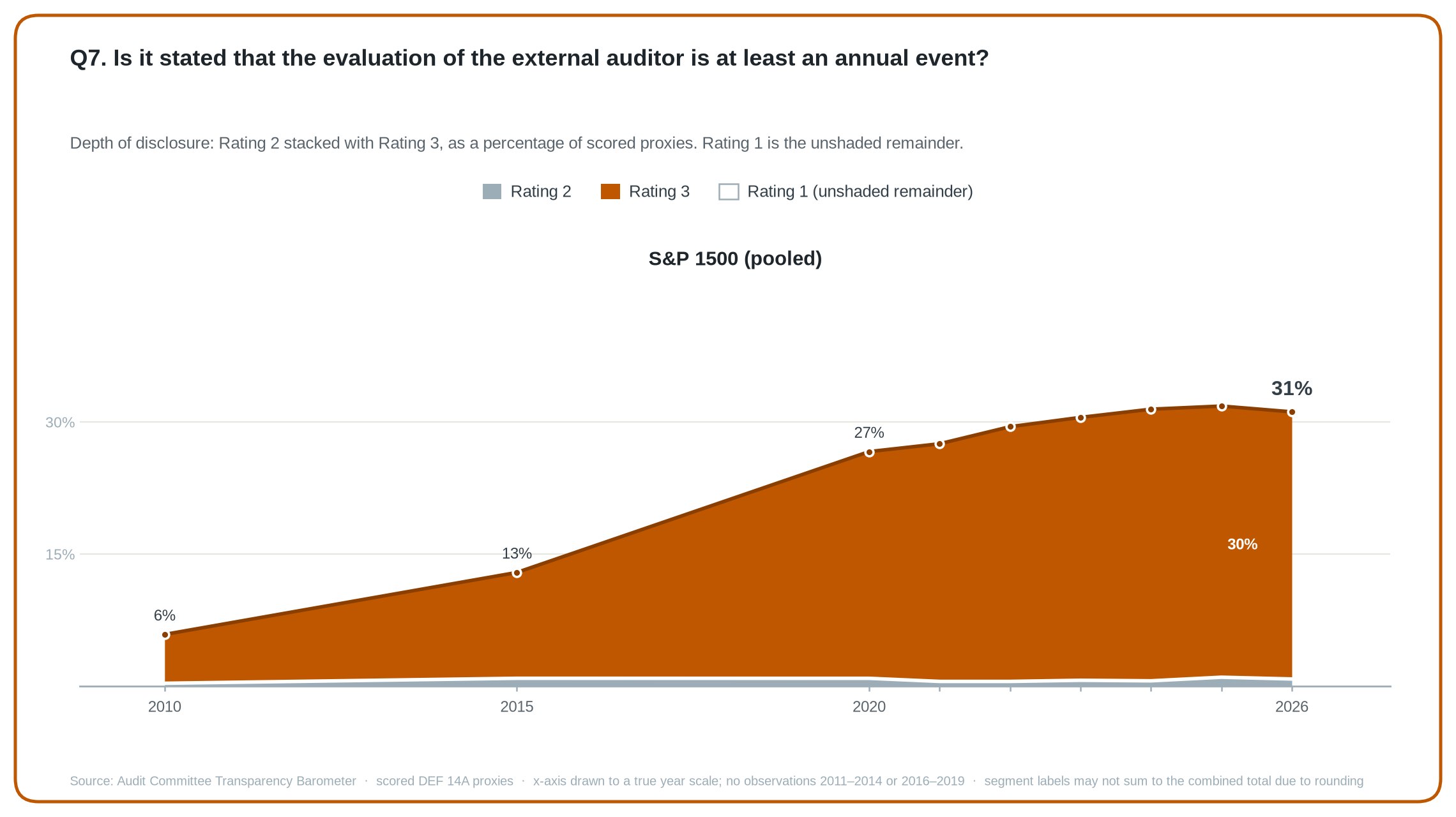
Is it stated that the evaluation of the external auditor is at least an annual event?
Construct. Does the proxy state that the external auditor is evaluated at least annually, and does it identify meaningful criteria, activities, or context for that evaluation?
Rating criteria
Rating 1 Baseline
Does not explicitly state annual or at-least-annual evaluation. "Regularly" and "periodically" remain Rating 1.
Rating 2 Partial
Explicitly states annual or at-least-annual evaluation but gives no named criterion, activity, or substantive context.
Rating 3 Full
Explicitly states annual or at-least-annual evaluation AND names at least one evaluation criterion, concrete activity, or substantive contextual detail.
Change over time
Share at Rating 2 and Rating 3, 2010–2026
Rating 2 (gold) stacked with Rating 3 (navy) as a share of scored proxies; Rating 1 is the unshaded remainder. No observations 2011–2014 or 2016–2019.Download PNGUnderlying shares by index, 2010 and 2026
Index
2010 · Rating 2 or 3
2026 · Rating 2 or 3
Change
2026 · Rating 2
2026 · Rating 3
2026 proxies
S&P 500
6%
44%
+38 pts
1%
43%
483
S&P MidCap 400
6%
25%
+19 pts
0%
25%
387
S&P SmallCap 600
6%
25%
+19 pts
1%
24%
577
S&P 1500
6%
31%
+25 pts
1%
30%
1,447
Share of scored DEF 14A proxies. “Rating 2 or 3” combines the two shaded tiers in the chart. Change is in percentage points, 2010 to 2026.
2026 exemplars 4 locked
Locked examples of strong disclosure from the 2026 proxy season. Evidence text is the coded reading of the filing, including the passages it quotes; the location points to where the disclosure appears. Rating 3 examples come first.
page 65 (PDF page 88), Proposal Two – Ratification of the Appointment of Ernst & Young LLP
Evidence
The proxy explicitly states that the external auditor is reviewed annually and specifies criteria evaluated in that review: "The Audit Committee reviews the performance of the independent registered public accounting firm annually. In making the determination to re-appoint Ernst & Young LLP for FY 2026, the Audit Committee considered, among other factors, the independence and performance of Ernst & Young LLP, and the quality and candor of Ernst & Young LLP’s communications with the Audit Committee and management." This directly satisfies Rating 3 by establishing annual frequency and naming substantive evaluation criteria (performance, independence, and quality/candor of communications).
Why this example
Opens with the identical annual-review sentence, then adds independence, performance, and quality and candor of communications considered in re-appointing Ernst & Young. | contrast: Near-perfect minimal pair with the R2 Jabil pick — the appended criteria sentence is exactly what earns Rating 3.
Original coding rationale
Clear, concise disclosure combining an explicit statement of annual review frequency with named evaluation criteria in the appointment context.
PDF page 45, Proposal No. 2 – Ratification of Independent Auditors, Oversight of Independent Auditor
Evidence
On PDF page 45, the proxy states: "In connection with the selection and appointment of the independent auditors each year, the Audit Committee reviews and evaluates the qualifications, performance, and independence of the independent auditors and lead partner including taking into account the opinions of management and the Company’s internal auditor." This explicitly states annual frequency ('each year') and names specific evaluation criteria ('qualifications, performance, and independence') and context ('opinions of management and the Company’s internal auditor'), directly matching the Rating 3 criterion and codebook example.
Why this example
'Each year' review of qualifications, performance, and independence of auditors and lead partner, informed by management and internal auditor opinions. | contrast: Shows 'each year' equals 'annually,' and that named criteria plus input sources comfortably clear the R2 line.
Original coding rationale
Canonical Rating 3 disclosure directly matching the codebook reference example, combining explicit annual frequency ('each year') with named evaluation criteria.
PDF page 46, ITEM 2 Ratification of the Independent Registered Public Accounting Firm (page 34)
Evidence
The disclosure satisfies Rating 3 by explicitly specifying an annual frequency for evaluating the independent auditor and identifying specific evaluation criteria, activities, and context. The proxy states: "At least annually, the Committee meets in executive session without PwC present to evaluate the quality of PwC's audit services and its performance, including PwC's industry knowledge from an accounting and tax perspective, PwC's continued independence and professional skepticism, the Committee's discussions with management about PwC's performance, and information available from Public Company Accounting Oversight Board ('PCAOB') inspection reports."
Why this example
'At least annually' executive-session evaluation citing audit quality, industry knowledge, independence, professional skepticism, and PCAOB inspection reports. | contrast: Illustrates the richer end of R3: at-least-annual cadence plus concrete activity and external evidence, not just an adjective list.
Original coding rationale
Clear and concise Rating 3 disclosure stating 'At least annually' and listing specific evaluative criteria and activities.
page 34, Proposal No. 2: Ratification of Appointment of Independent Registered Public Accounting Firm
Evidence
On page 34, under Proposal 2, the proxy explicitly states: 'The Audit Committee reviews the performance of the independent registered public accounting firm annually.' This explicitly establishes that the external auditor's performance is reviewed annually, but provides no named evaluation criteria, concrete activities (e.g., surveys, questionnaires, inspection reviews), or contextual details. Under the codebook, a bare statement of annual evaluation without named criteria or substantive context is Rating 2.
Why this example
'The Audit Committee reviews the performance of the independent registered public accounting firm annually' — explicit annual cadence, but no named criterion, activity, or context. | contrast: Bare cadence sentence: beats R1's 'periodically' yet lacks the named criteria that would lift it to 3.
Original coding rationale
Representative example of Rating 2 where the annual frequency of the auditor evaluation is explicitly stated ('The Audit Committee reviews the performance of the independent registered public accounting firm annually') but without any accompanying evaluation criteria, activities, or contextual detail.
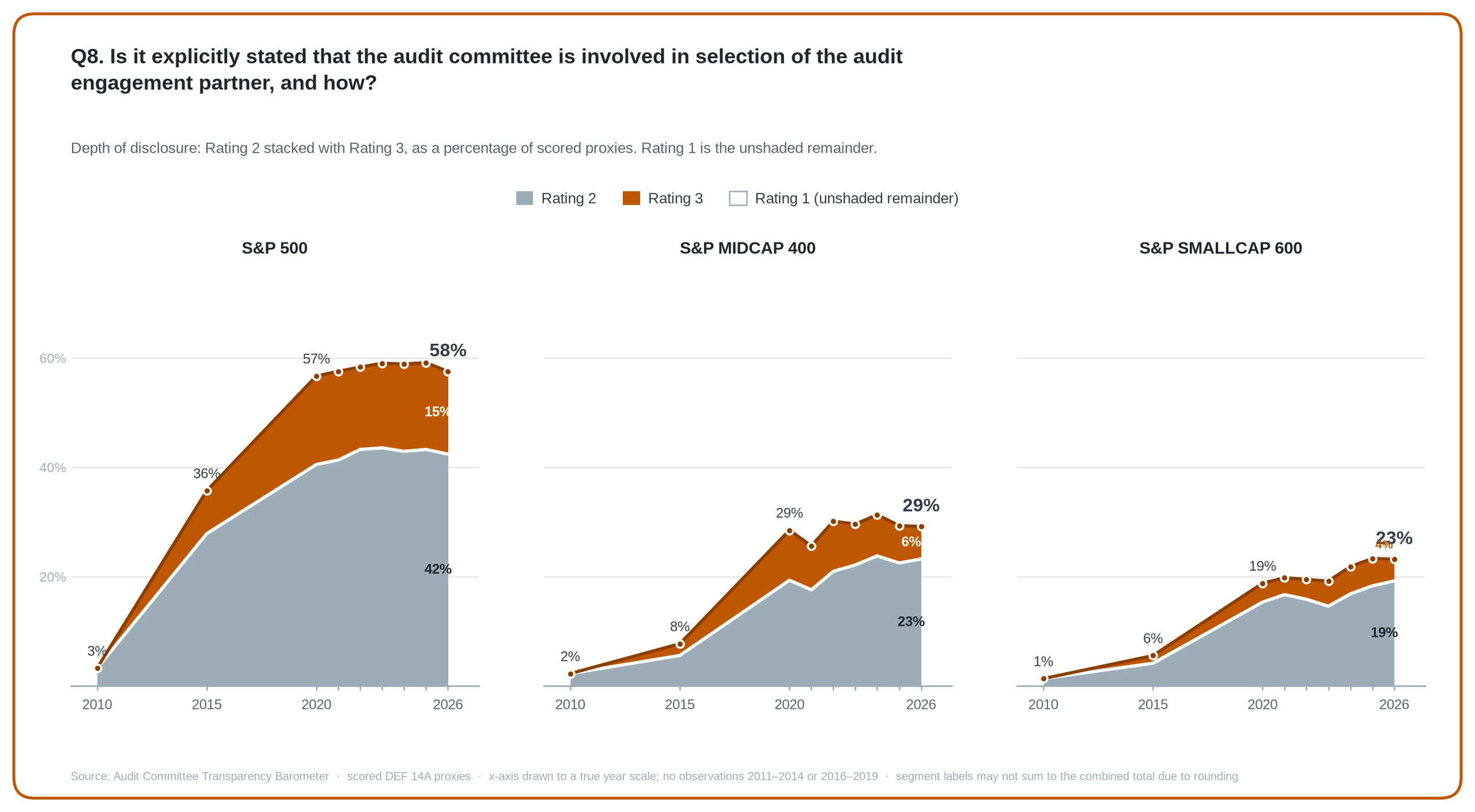
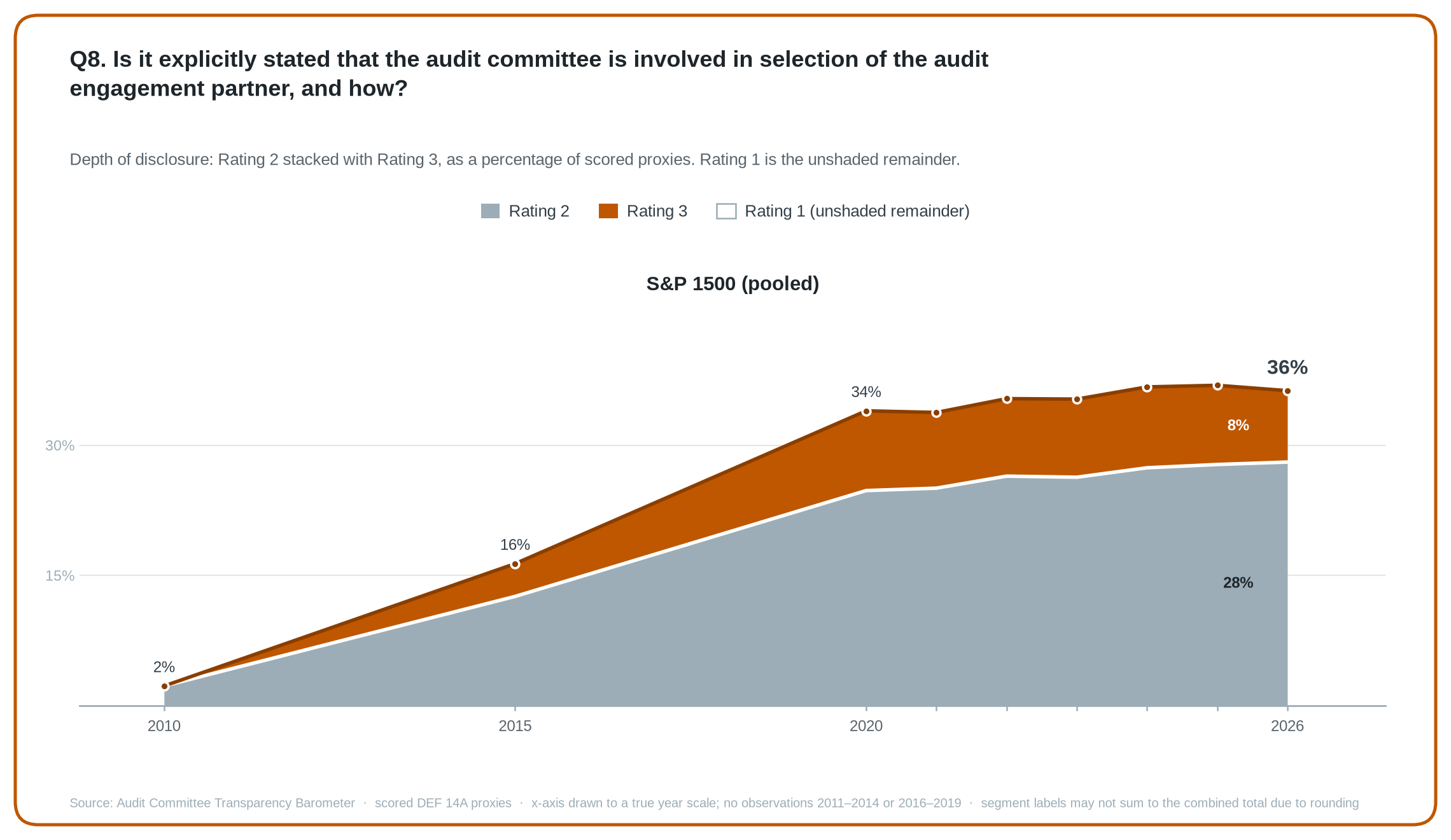
Q8 Committee Involvement in Engagement Partner Selection
Is it explicitly stated that the audit committee is involved in selection of the audit engagement partner, and how?
Construct. How specifically does the proxy describe the audit committee's role in selecting the lead or engagement partner?
Rating criteria
Rating 1 Baseline
No committee role in partner selection: only mandatory rotation with no committee role, a generic firm/audit-team evaluation that does not name the partner, or no partner-selection disclosure.
Rating 2 Partial
Claims a committee role, involvement, participation, or approval responsibility but names no concrete selection action; also includes review of the lead partner only as an input to retaining or evaluating the audit firm.
Rating 3 Full
Names a concrete committee action in a partner decision: interviews or meets candidates, reviews or evaluates candidates for the role, selects, appoints, actually approves an appointment, or votes.
In the v30 instrument this question absorbs the earlier sub-question Q8_1.
Change over time
Share at Rating 2 and Rating 3, 2010–2026
Rating 2 (gold) stacked with Rating 3 (navy) as a share of scored proxies; Rating 1 is the unshaded remainder. No observations 2011–2014 or 2016–2019.Download PNGUnderlying shares by index, 2010 and 2026
Index
2010 · Rating 2 or 3
2026 · Rating 2 or 3
Change
2026 · Rating 2
2026 · Rating 3
2026 proxies
S&P 500
3%
58%
+54 pts
42%
15%
483
S&P MidCap 400
2%
29%
+27 pts
23%
6%
387
S&P SmallCap 600
1%
23%
+22 pts
19%
4%
577
S&P 1500
2%
36%
+34 pts
28%
8%
1,447
Share of scored DEF 14A proxies. “Rating 2 or 3” combines the two shaded tiers in the chart. Change is in percentage points, 2010 to 2026.
2026 exemplars 4 locked
Locked examples of strong disclosure from the 2026 proxy season. Evidence text is the coded reading of the filing, including the passages it quotes; the location points to where the disclosure appears. Rating 3 examples come first.
Page 76 (PDF page 100), Proposal 3 — Ratification of Appointment of Ernst & Young LLP as Independent Auditor
Evidence
The proxy explicitly describes concrete committee actions in the selection of the engagement partner: "In accordance with SEC rules, lead audit partners are subject to rotation requirements, which limit the number of consecutive years an individual partner may serve us. The Audit Committee oversees the rotation of the audit partners. The Audit Committee Chair interviews candidates for audit partner and the Audit Committee discusses them." Naming that the Audit Committee Chair interviews candidates and the Audit Committee discusses them represents concrete actions in the partner selection process, directly matching the codebook's Rating 3 criterion (and serving as a named codebook example).
Why this example
'The Audit Committee Chair interviews candidates for audit partner and the Audit Committee discusses them' — a concrete, committee-performed selection action. | contrast: Minimal-but-sufficient R3: one named act (interviewing candidates) is all that separates it from R2 involvement claims.
Original coding rationale
This passage is a clear, concise, and quintessential example of Rating 3 disclosure for engagement partner selection, explicitly describing that the Chair interviews candidates and the full committee discusses them.
The proxy details specific, concrete actions taken by the Audit Committee in the selection of the lead engagement partner. In the Audit Committee Report under 'Independent Auditor Tenure and Rotation', the proxy states: "The Audit Committee also oversees the process for the selection of the lead audit engagement partner every five years. At the Audit Committee’s instruction, PwC selects candidates to be considered for this role, who are then interviewed by Broadcom’s senior management and the Audit Committee. The Audit Committee then considers and votes on the selection." This disclosure names explicit selection actions: instructing PwC to present candidates, interviewing candidates, and considering and voting on the selection, fully satisfying Rating 3.
Why this example
Committee instructs PwC to produce candidates, interviews them, then 'considers and votes on the selection' — the fullest concrete decision chain. | contrast: Ceiling case: an explicit committee vote shows the maximum distance from R2's unspecified 'involvement'.
Original coding rationale
Provides a clear, textbook illustration of Rating 3 disclosure for engagement partner selection, naming committee instructions, candidate interviews, and voting.
The proxy statement states that the audit committee and its chairperson are involved in the selection of the lead audit partner, but does not identify a concrete selection action (such as interviewing candidates, reviewing candidate profiles, or voting). On page 26, under Independent Auditor, the proxy states: 'In addition, in conjunction with the mandated rotation of Deloitte’s lead audit partner, the audit committee and the audit committee chairperson are directly involved in the selection of Deloitte’s lead audit partner'. Under the codebook rules, stating that the committee is 'directly involved in the selection' without naming a specific concrete action is the textbook definition of Rating 2.
Why this example
Audit committee and chairperson are 'directly involved in the selection of Deloitte's lead audit partner,' asserting a role without naming any concrete selection step. | contrast: Canonical R2: 'directly involved' is the exact phrase that stops short of R3's interviews, meetings, or votes.
Original coding rationale
Matches the exact phrasing of the codebook's Ryder example ('directly involved in the selection'), providing an ideal benchmark for Rating 2.
PDF page 92, Audit and Finance Committee Matters — Report of the Audit and Finance Committee for Fiscal 2025
Evidence
The proxy claims a role and participation for the Audit Committee in lead partner selection without describing a concrete selection activity (such as interviewing candidates, reviewing candidate profiles, or voting). On page 73, the Audit Committee Report states: 'PwC rotates its lead audit engagement partner every five years, and the Audit Committee takes a lead role in the process for evaluating and selecting the new lead audit engagement partner. PwC\'s lead audit engagement partner rotated following the filing of the Company\'s Fiscal 2025 Form 10-K.' Stating that the committee 'takes a lead role in the process for evaluating and selecting' asserts committee involvement but names no specific selection action, qualifying for Rating 2.
Why this example
Committee 'takes a lead role in the process for evaluating and selecting the new lead audit engagement partner' — strong role language, but no named action. | contrast: Hardest R2/R3 boundary: 'evaluating and selecting' sounds concrete, yet no candidate interview, review, or vote is described.
Original coding rationale
Demonstrates the boundary between Rating 2 and Rating 3 for engagement partner selection, where the proxy asserts that the committee 'takes a lead role in the process for evaluating and selecting' but does not name concrete actions such as interviews or votes.
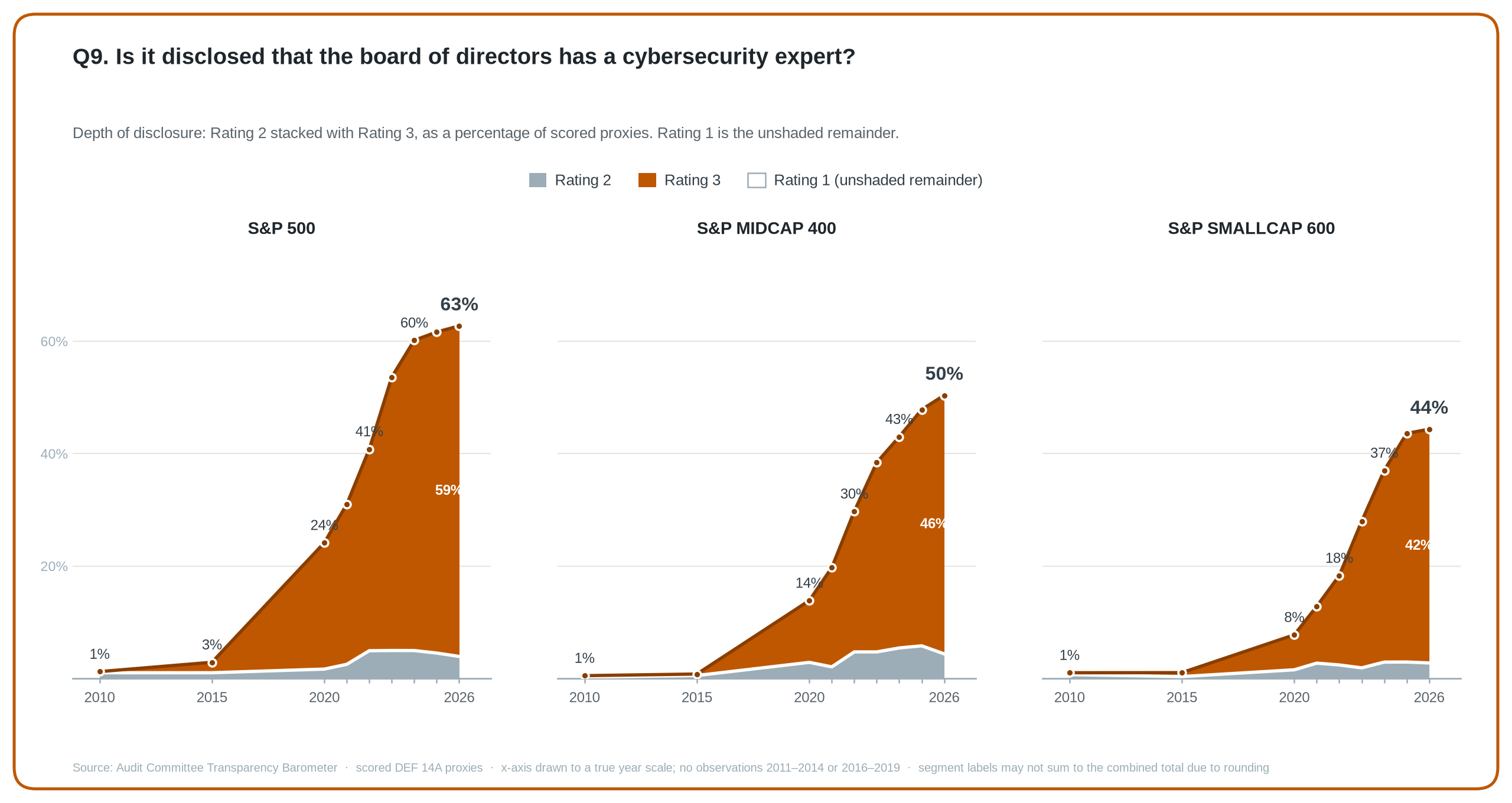
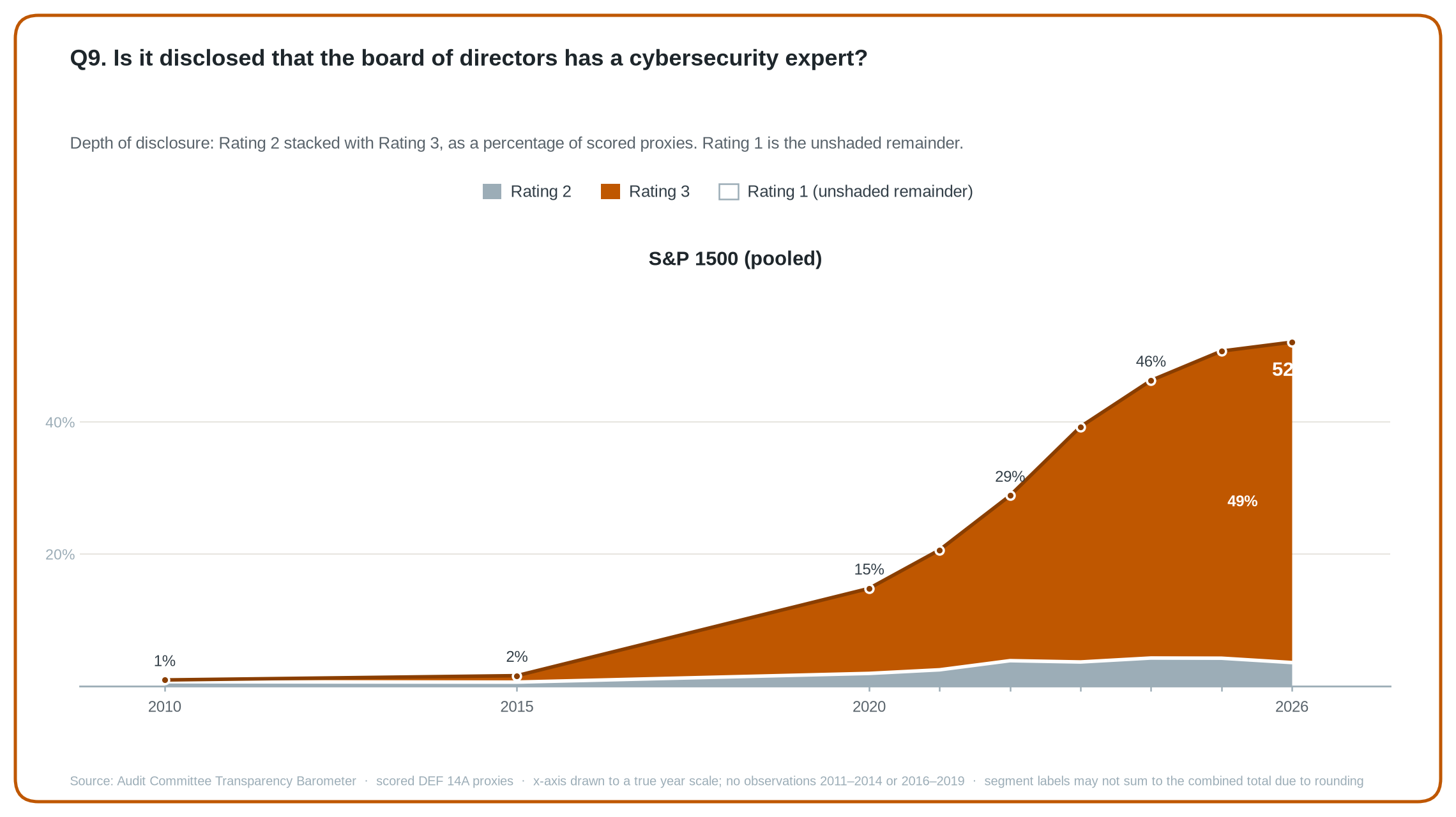
Is it disclosed that the board of directors has a cybersecurity expert?
Construct. Does the proxy explicitly identify a director with cybersecurity expertise through a skills matrix or as a primary career focus?
Rating criteria
Rating 1 Baseline
Neither applies. General technology experience, supplemental certifications, or passing mentions of cybersecurity as one element of a broader IT role do not qualify.
Rating 2 Partial
A closely adjacent security term appears — "Information Security," "Data Security," "IT Security," "Network Security," or "Data Privacy" — in the skills matrix category name or as the primary description of a director's expertise, without the word "Cybersecurity."
Rating 3 Full
The word "Cybersecurity," "Cyber Security," or the truncated form "Cyber" (as in "Cyber / IT," "Cyber Risk") appears in the skills matrix category name (e.g., "Cybersecurity," "Cybersecurity and Data Privacy," "Cybersecurity/IT," "Technology, Cybersecurity and Innovation," "Cyber / IT"). OR a director whose primary career or board expertise is described using the word "cybersecurity."
Change over time
Share at Rating 2 and Rating 3, 2010–2026
Rating 2 (gold) stacked with Rating 3 (navy) as a share of scored proxies; Rating 1 is the unshaded remainder. No observations 2011–2014 or 2016–2019.Download PNGUnderlying shares by index, 2010 and 2026
Index
2010 · Rating 2 or 3
2026 · Rating 2 or 3
Change
2026 · Rating 2
2026 · Rating 3
2026 proxies
S&P 500
1%
63%
+62 pts
4%
59%
483
S&P MidCap 400
1%
50%
+50 pts
4%
46%
387
S&P SmallCap 600
1%
44%
+43 pts
3%
42%
577
S&P 1500
1%
52%
+51 pts
4%
49%
1,447
Share of scored DEF 14A proxies. “Rating 2 or 3” combines the two shaded tiers in the chart. Change is in percentage points, 2010 to 2026.
2026 exemplars 5 locked
Locked examples of strong disclosure from the 2026 proxy season. Evidence text is the coded reading of the filing, including the passages it quotes; the location points to where the disclosure appears. Rating 3 examples come first.
PDF page 17, Proposal 1: Election of Directors — Board Skills and Expertise; PDF page 29, Director Nominees — William M. Thornberry
Evidence
On PDF page 17 (Proposal 1: Election of Directors — Board Skills and Expertise), the board skills matrix contains a specific category titled "Cybersecurity / Information Security / Information Tech" mapped to seven director nominees (Dial, Flournoy, Jewett, McClain, Nolan, Read, and Thornberry). Under the Q9 bright-line rule, because the exact category name in the skills matrix contains the word "Cybersecurity", this qualifies for Rating 3. (Additionally, on PDF page 29, William M. Thornberry's biography details his "involvement and expertise in oversight of cybersecurity-related risks at the Departments of Defense and Homeland Security... and chaired the Cyber Task Force in 2011").
Why this example
Booz Allen's matrix category is "Cybersecurity / Information Security / Information Tech," mapped to seven nominees; Thornberry's bio adds DoD/DHS cyber oversight. | contrast: Same compound label as R2 cases but adds "Cybersecurity" first — one word moves it from 2 to 3.
Original coding rationale
Clear illustration of a structured skills matrix column containing 'Cybersecurity' in the category label mapped to specific individual director nominees.
PDF page 26, Proposal 1 – Summary of Board Skills; PDF page 9, Proxy Summary – Director Skills and Experience
Evidence
The proxy statement includes a structured board skills matrix with an explicit competency category labeled "Cybersecurity" mapped to individual directors. On PDF page 26, the "Summary of Board Skills" matrix includes a row labeled "Cybersecurity" indicating that 4 out of 8 director nominees possess this core competency (with indicators marked for Kapila K. Anand, Craig R. Callen, Barbara B. Hill, and Burke W. Whitman). In addition, on PDF page 9 (Proxy Summary), the skills summary bar chart includes the category "CYBER". Under the Q9 codebook rule, when the exact term "Cybersecurity" or "Cyber" appears in the skills matrix category name, the disclosure qualifies for Rating 3.
Why this example
Standalone "Cybersecurity" row in the Summary of Board Skills matrix mapped to four nominees, plus a "CYBER" skills category in the proxy summary. | contrast: The cleanest R3 anchor: a dedicated, unqualified "Cybersecurity" category label with no adjacent-term hedging.
Original coding rationale
Provides an unambiguous example of Rating 3 via a dedicated 'Cybersecurity' category row in a director-level board skills matrix.
PDF page 52, PROPOSAL 1: Election of Directors - David C. Wajsgras; PDF page 40, Board Refreshment Timeline
Evidence
On page 33 (PDF page 52), director nominee David C. Wajsgras is explicitly identified as: "Chairman and Chief Executive Officer of Everfox, a leading global cybersecurity company." Under his Key Attributes, the proxy highlights his "Expertise in cybersecurity products and services." Furthermore, on page 23 (PDF page 40), he is highlighted as "A highly regarded aerospace, defense, and cybersecurity executive... with deep expertise in risk management and advanced technology solutions." Because Mr. Wajsgras serves as CEO of a cybersecurity company and cybersecurity is a primary defining feature of his executive leadership and board expertise, this satisfies the biography test for Rating 3.
Why this example
No cyber matrix label, but Wajsgras is Chairman/CEO of Everfox, "a leading global cybersecurity company," with expertise in cybersecurity products and services. | contrast: Demonstrates the biography path to R3 — a security-defined career, versus R1's coordinate-list mentions.
Original coding rationale
Clear illustration of meeting Rating 3 via the director biography criteria (CEO of a global cybersecurity company with explicit cybersecurity expertise) when the board skills matrix uses a general technology category label.
PDF pages 79-80 (Proxy Statement pages 34-35), Board Skills Matrix; PDF page 83 (Proxy Statement page 37), Director Biographies
Evidence
The Board Skills Matrix on pages 34-35 includes a specific category titled 'Information Security Experience' (an adjacent security term without the word 'Cybersecurity' in the category name), mapped to individual directors (Ms. Arnold, Mr. Blackmore, Mr. Landless, Mr. Parrette). The description notes 'Experience in management of IT functions, carrying out IT risk assessments and audits, implementing IT security policies and knowledge and management of IT capabilities and risks associated with cyber security matters.' Furthermore, in director biographies, Ms. Arnold's bio mentions 'experience in information technology, including cyber security' in a coordinate list alongside industry knowledge and financial expertise, which is a secondary mention rather than a primary career focus.
Why this example
Matrix category name is "Information Security Experience"; "cyber security" appears only in the descriptor text and a bio coordinate list, not the label. | contrast: Boundary case: cyber wording present but outside the category name, so it stays at 2 rather than 3.
Original coding rationale
Excellent example of Rating 2 under the category name bright-line test: the skills matrix category title is 'Information Security Experience' (an adjacent security term without 'Cybersecurity' in the heading), even though the underlying descriptor text mentions cyber security.
PDF page 23, PROPOSAL ONE: ELECTION OF DIRECTORS - Board Skills and Demographic Matrix
Evidence
In the 'Board Skills and Demographic Matrix' on PDF page 23, the proxy includes the category 'Information Technology / IT Security Experience'. Under the codebook rule, when an adjacent security term appears ('IT Security' or 'Information Security') in the skills matrix category label without the word 'Cybersecurity', 'Cyber Security', or 'Cyber', the disclosure is rated 2. Three director nominees (Barry, Cafritz, and Weiner) are marked for this category. None of the director biographies describe cybersecurity as a primary career focus or defining expertise.
Why this example
Board skills matrix category is "Information Technology / IT Security Experience," marked for three nominees; "IT Security" is an enumerated adjacent term without "Cyber." | contrast: Tests a second adjacent term (IT Security) and separates it from R3's "Cyber / IT" phrasing.
Original coding rationale
Clear example of Rating 2 where the board skills matrix uses the exact adjacent security term 'IT Security' rather than 'Cybersecurity'.
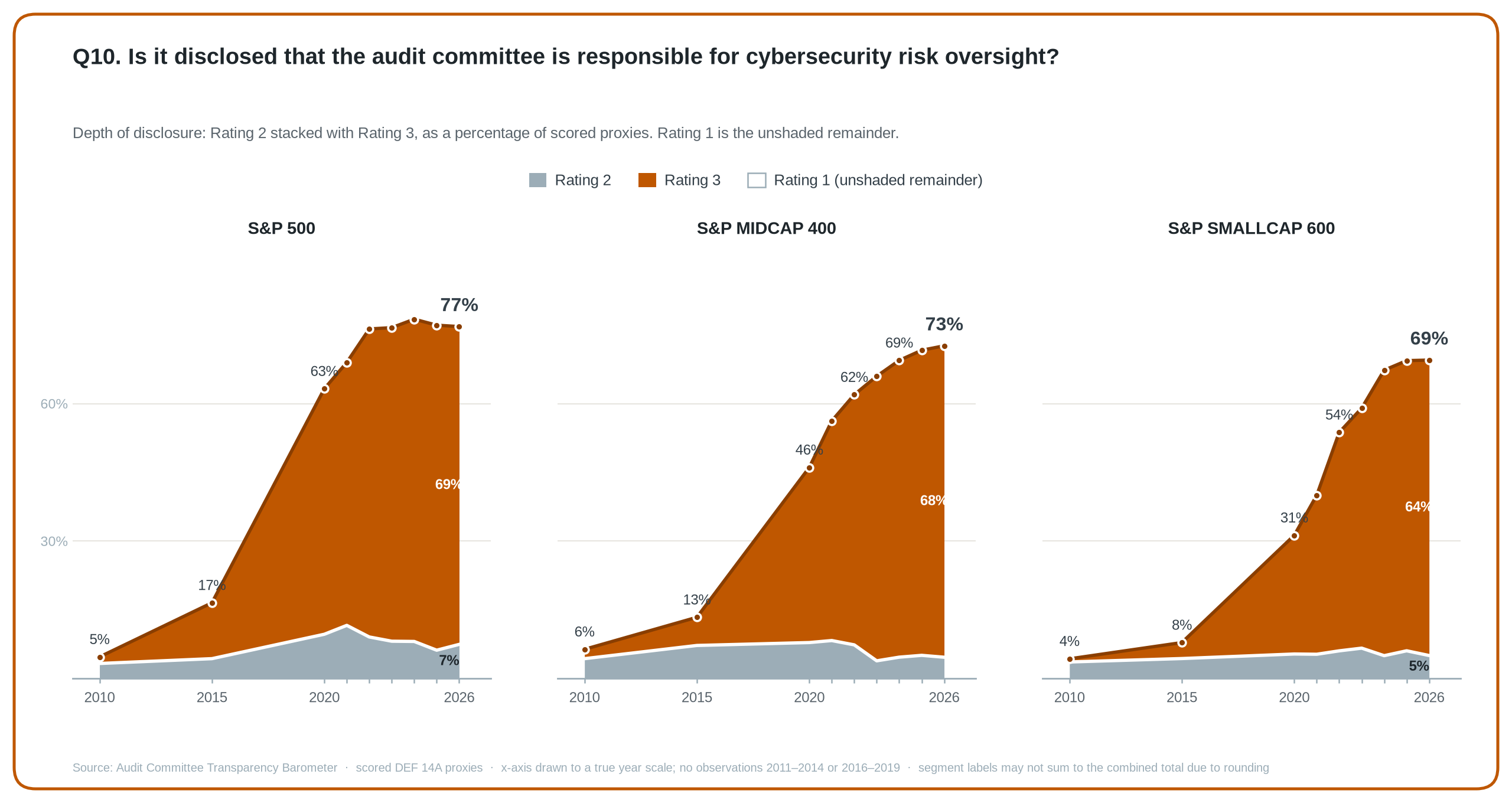
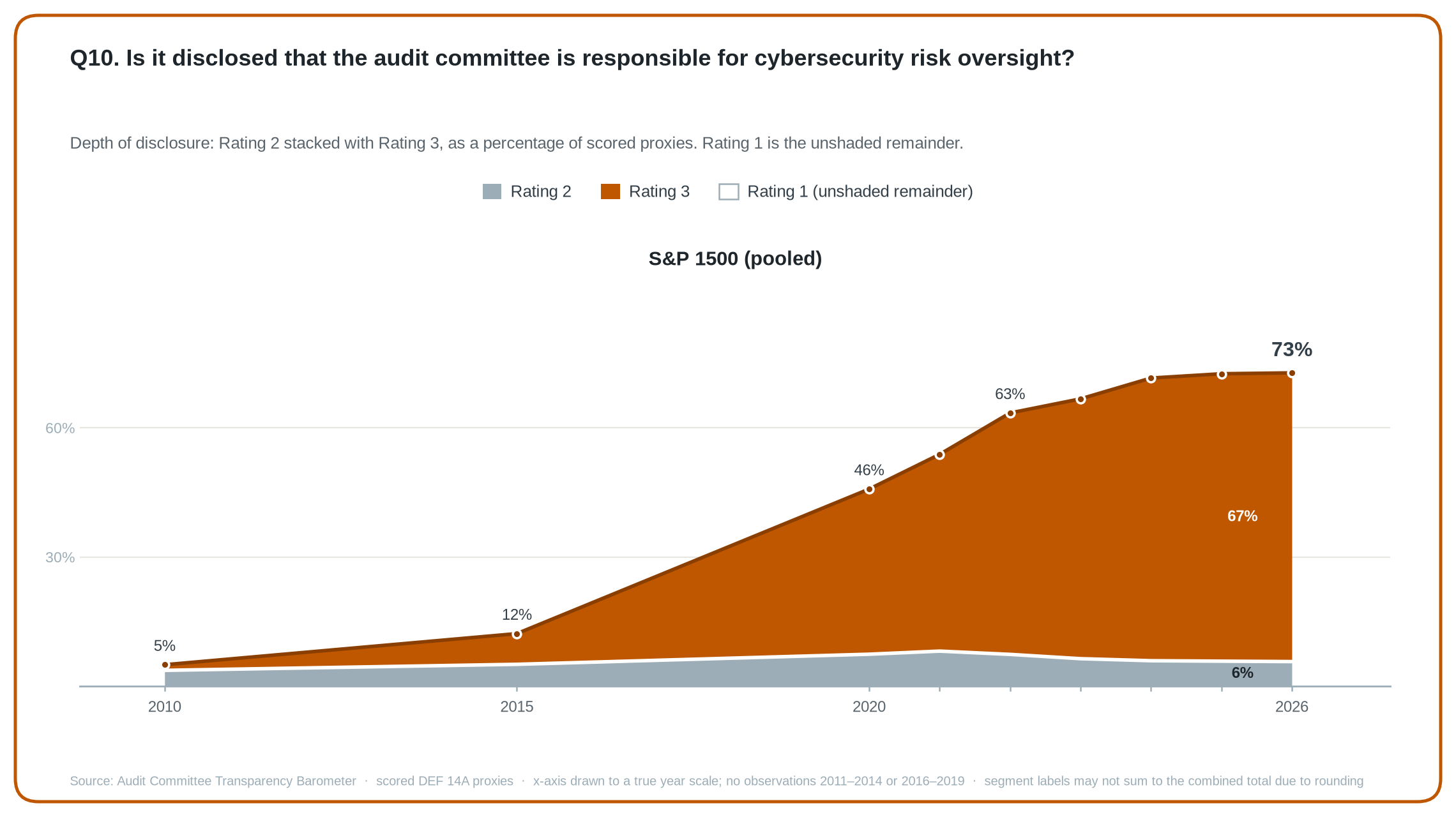
Q10 Audit Committee Responsible for Cybersecurity Oversight
Is it disclosed that the audit committee is responsible for cybersecurity risk oversight?
Construct. Does the proxy assign cybersecurity oversight to the audit committee?
Rating criteria
Rating 1 Baseline
General risk oversight with no tech/cyber dimension; cyber assigned to a different committee.
Rating 2 Partial
Audit committee's risk oversight includes language that could encompass cyber ("technology risk," "information systems risk") but does not specifically name cybersecurity.
Rating 3 Full
Cybersecurity, information security, or data privacy oversight explicitly assigned to the audit committee by name.
Change over time
Share at Rating 2 and Rating 3, 2010–2026
Rating 2 (gold) stacked with Rating 3 (navy) as a share of scored proxies; Rating 1 is the unshaded remainder. No observations 2011–2014 or 2016–2019.Download PNGUnderlying shares by index, 2010 and 2026
Index
2010 · Rating 2 or 3
2026 · Rating 2 or 3
Change
2026 · Rating 2
2026 · Rating 3
2026 proxies
S&P 500
5%
77%
+72 pts
7%
69%
483
S&P MidCap 400
6%
73%
+66 pts
5%
68%
387
S&P SmallCap 600
4%
69%
+65 pts
5%
64%
577
S&P 1500
5%
73%
+68 pts
6%
67%
1,447
Share of scored DEF 14A proxies. “Rating 2 or 3” combines the two shaded tiers in the chart. Change is in percentage points, 2010 to 2026.
2026 exemplars 4 locked
Locked examples of strong disclosure from the 2026 proxy season. Evidence text is the coded reading of the filing, including the passages it quotes; the location points to where the disclosure appears. Rating 3 examples come first.
PDF page 15, Proxy Statement Summary — Strategy and Risk Oversight — Cybersecurity; PDF page 67, Governance — Committees of the Board — Audit Committee; PDF page 73, Governance — Board Oversight — Cybersecurity
Evidence
Cybersecurity oversight is explicitly and repeatedly assigned to the Audit Committee by name. PDF page 15 states: "The Audit Committee is responsible for oversight of our programs, policies, procedures, and risk management activities related to information security, cybersecurity and data protection. It meets regularly with management to discuss threats, risks, and ongoing efforts to enhance cyber resiliency, as well as changes to the broader cybersecurity landscape." PDF page 67 confirms under Audit Committee key responsibilities: "oversees the company’s programs, policies, procedures, and risk management activities related to information security, cybersecurity and data protection".
Why this example
Audit Committee is expressly 'responsible for oversight of our programs, policies, procedures, and risk management activities related to information security, cybersecurity and data protection.' | contrast: Unambiguous R3 anchor: dedicated cyber responsibility stated in both charter duties and the risk oversight narrative.
Original coding rationale
Exemplary Rating 3 disclosure with unambiguous, direct assignment of cybersecurity and data protection oversight to the Audit Committee across multiple sections.
PDF page 35, Corporate Governance — Risk Oversight; PDF page 36, Corporate Governance — Data Privacy and Cybersecurity Risk Oversight; PDF page 41, Corporate Governance — Board Committees — Audit & Finance Committee
Evidence
The proxy explicitly assigns data privacy and cybersecurity oversight to the Audit and Finance Committee by name in multiple dedicated sections. On PDF page 36, under "DATA PRIVACY AND CYBERSECURITY RISK OVERSIGHT", the proxy states: "The Audit and Finance Committee of the Board oversees the Company’s data privacy and cybersecurity programs as well as risk exposures and steps taken by management to monitor and mitigate data privacy and cybersecurity risks." In addition, the committee's key oversight responsibilities listed on PDF page 35 and PDF page 41 explicitly include "Oversight of our Data Privacy and Cybersecurity programs." This unambiguous assignment satisfies Rating 3.
Why this example
A dedicated 'Data Privacy and Cybersecurity Risk Oversight' section assigns the programs and risk exposures to the Audit and Finance Committee by name. | contrast: Shows R3 survives a combined audit/finance committee; the dedicated cyber section names that committee, not the Board.
Original coding rationale
The disclosure provides an exceptionally clear, dedicated subsection with explicit language delegating cybersecurity and data privacy oversight directly to the Audit and Finance Committee.
PDF pages 20-21, Board of Directors and Corporate Governance - Risk Management Oversight and Cybersecurity Risk Management
Evidence
Under Risk Management Oversight on page 20, the proxy states: "Our Audit Committee oversees and reviews with management our policies with respect to risk assessment and risk management and our significant operational, financial, information technology and regulatory exposures, among others, and the actions management has taken to limit, monitor or control such exposures." Under Cybersecurity Risk Management on page 20, the proxy states: "The Board is responsible for oversight over the Company’s cybersecurity risk management." Under Q10 rules, when the Audit Committee's oversight includes language that could encompass cyber ("information technology... exposures") without specifically naming cybersecurity, and dedicated cybersecurity oversight is assigned to the full Board, the disclosure receives Rating 2.
Why this example
Audit Committee oversees 'information technology' exposures generically, while the dedicated cybersecurity paragraph assigns cybersecurity risk management to the full Board. | contrast: Bridges R1 and R3: IT-risk language in audit's mandate lifts it above R1, but named cyber oversight sits with the Board.
Original coding rationale
Clearly illustrates Rating 2 where the Audit Committee has general 'information technology' exposure oversight while dedicated cybersecurity oversight is assigned to the full Board.
Page 18, Board’s Role in Risk Oversight (PDF page 44)
Evidence
The proxy assigns risk oversight encompassing technology and information risk to the Audit Committee, but does not specifically name cybersecurity. Under "Board’s Role in Risk Oversight" on page 18 (PDF page 44), the Audit Committee's responsibilities include: "Overseeing the integrity of the Company's financial statements and financial reporting processes; overseeing our policies and processes on enterprise risk assessment, risk management, and compliance, including technology and information risk; overseeing our most significant financial reporting and accounting control risks...". Under the Q10 codebook rule, when the audit committee's oversight includes language that could encompass cyber (such as "technology risk" or "information risk") without specifically using the term cybersecurity, information security, or data privacy, Rating 2 is assigned.
Why this example
Audit Committee oversees enterprise risk 'including technology and information risk' but the proxy never names cybersecurity, information security, or data privacy. | contrast: Core R2 case: cyber-encompassing 'technology and information risk' wording without the explicit cyber term that would make it R3.
Original coding rationale
A representative example of Rating 2 where the Audit Committee is explicitly assigned oversight of 'technology and information risk' in the board risk oversight section, which encompasses cyber risk without using the explicit word 'cybersecurity'.
Is it disclosed that the board of directors has a skills matrix?
Construct. Does the proxy include a structured skills disclosure?
Rating criteria
Rating 1 Baseline
Only narrative descriptions of individual director qualifications. No structured skills disclosure.
Rating 2 Partial
A partial or informal skills presentation: collective board competency summary, structured qualifications that are not a traditional director-level matrix.
Rating 3 Full
A skills matrix, skills table, or equivalent structured disclosure mapping directors to competency areas is present or referenced.
Change over time
Share at Rating 2 and Rating 3, 2010–2026
Rating 2 (gold) stacked with Rating 3 (navy) as a share of scored proxies; Rating 1 is the unshaded remainder. No observations 2011–2014 or 2016–2019.Download PNGUnderlying shares by index, 2010 and 2026
Index
2010 · Rating 2 or 3
2026 · Rating 2 or 3
Change
2026 · Rating 2
2026 · Rating 3
2026 proxies
S&P 500
9%
93%
+84 pts
10%
83%
483
S&P MidCap 400
4%
84%
+80 pts
17%
67%
387
S&P SmallCap 600
3%
72%
+69 pts
12%
60%
577
S&P 1500
5%
82%
+77 pts
12%
70%
1,447
Share of scored DEF 14A proxies. “Rating 2 or 3” combines the two shaded tiers in the chart. Change is in percentage points, 2010 to 2026.
2026 exemplars 5 locked
Locked examples of strong disclosure from the 2026 proxy season. Evidence text is the coded reading of the filing, including the passages it quotes; the location points to where the disclosure appears. Rating 3 examples come first.
PDF page 10, Proposal 1: Election of Directors; PDF page 33, Nomination of Directors
Evidence
On page 10, under Proposal 1: Election of Directors, the proxy contains a structured skills matrix table that maps each of the nine director nominees individually across eight distinct competency categories (Accounting & Corporate Finance, Software Industry Knowledge, Transformation Experience, Strategy and Management, Technology Expertise, Corporate Governance, Risk Management (including Cybersecurity Expertise), and Regulatory Industry Knowledge) using individual checkmarks. Page 33 also explicitly references: "See the Skills Matrix immediately prior to our director and nominee biographies under Proposal 1—Election of Directors." This provides a clear director-level mapping, satisfying Rating 3.
Why this example
Grid maps each of nine nominees to eight competencies with checkmarks, and a later governance section explicitly cross-references the skills matrix. | contrast: Demonstrates the 'present or referenced' clause while still showing the actual director-level mapping.
Original coding rationale
Clear, clean example of a director-level skills matrix mapping each nominee to specific competency categories with individual checkmarks.
PDF page 11, Proposal 1 - Board of Directors Skills Matrix
Evidence
On page 11, under the section heading "BOARD OF DIRECTORS SKILLS MATRIX," the proxy presents a structured grid mapping all nine individual director nominees (Brian Chambers, Michelle Collins, Eduardo Cordeiro, Adrienne Elsner, Alfred Festa, Edward Lonergan, Paul Martin, Suzanne Nimocks, John Williams) across 12 distinct competency categories: Public Company Management, Strategy / Corporate Development, Business Transformation Leadership, Financial, Technology / Cybersecurity, Research & Development / Product Innovation, Global Business, Manufacturing / Operations, Marketing / Sales, Sustainability Management, Public Policy / Regulatory, and Human Capital Management. This satisfies the codebook criterion for Rating 3.
Why this example
Section titled 'Board of Directors Skills Matrix' maps all nine named nominees across twelve competency categories in a structured grid. | contrast: Canonical Rating 3 anchor: named directors as rows, competencies as columns — exactly what Rating 2 lacks.
Original coding rationale
Textbook example of a structured director-by-skill matrix table meeting the Rating 3 standard.
PDF page 24, Corporate Governance — Board Skills and Experience Matrix
Evidence
On PDF page 24, under Corporate Governance — Board Skills and Experience Matrix, the proxy includes a structured grid mapping nine continuing directors individually across 10 competency categories (Automotive Industry, Senior Management, Finance / Accounting, International Business, Legal / Regulatory / Compliance, Corporate Governance and Public Company Board, Semiconductor / Technology Industries, Sales & Marketing, Operations / Manufacturing / Supply Chain, and Corporate Responsibility / Climate / Sustainability) using five proficiency levels (no experience, emerging experience, some experience, substantial experience, expert-level experience). This satisfies the Rating 3 criterion for a structured disclosure mapping individual directors to competency areas.
Why this example
Board Skills and Experience Matrix maps nine directors across ten categories using five graded proficiency levels rather than binary marks. | contrast: Graded per-director proficiency exceeds Rating 2's aggregate counts, showing depth is mapped to individuals.
Original coding rationale
Presents a classic director-level skills matrix mapping individual directors across multiple competency areas with defined proficiency levels.
PDF page 40, Corporate Governance and Board Matters - Director Nominees - Experience and Qualifications of All Nominees
Evidence
The proxy satisfies Rating 2 because it presents a structured skills disclosure in the form of a collective board competency summary bar chart rather than an individual director-by-skill matrix grid. The proxy states: 'The graph below shows the number of directors who have certain of the skills, qualifications and experience in key areas that are important for the Board’s oversight of the Company’s business. DIRECTOR SKILLS MATRIX (Number of directors with relevant skills)' and displays aggregate counts across 9 competency areas. While individual biographies contain bulleted 'Qualification Highlights', there is no tabular grid mapping each director against the full set of competency categories.
Why this example
Chart literally titled 'Director Skills Matrix' but shows only aggregate counts per skill; biographies list qualification highlights, with no director-by-skill grid. | contrast: Teaches that the label 'matrix' does not earn Rating 3 — only actual director-to-competency mapping does.
Original coding rationale
Representative example of a collective aggregate skills chart titled 'Director Skills Matrix' that qualifies for Rating 2 rather than Rating 3 due to the absence of director-by-skill tabular mapping.
PDF pages 31, 33, 34, 36, 38, Proposal 1 — Election of Director Nominees For Terms Expiring At The 2027 Annual Meeting
Evidence
The proxy provides a structured presentation of director qualifications using individual "KEY SKILLS" sidebars with standardized category icons and labels alongside each nominee's biography, rather than a consolidated director-by-skill matrix table. The standardized competency labels across the nominees are: "Audit/Finance", "Brand & Marketing", "CEO/CFO Experience", "Dealers/Distribution", "Global", "Governance and Compliance", "Operations/Manufacturing", "Public Company Board", and "Technology/Innovation/Digital". Under the Q13 criteria, "structured qualifications that are not a traditional director-level matrix" receive Rating 2.
Why this example
Standardized 'Key Skills' labels appear in each nominee's biography sidebar with consistent categories, but never consolidated into a director-by-competency table. | contrast: Shows per-director skill tags alone fall short of Rating 3; the structured cross-director grid is what lifts it.
Original coding rationale
Excellent illustration of Rating 2 where standardized skills icons and categories are presented alongside individual director biographies rather than in a unified director-level matrix table.
Is it disclosed that the board of directors has an AI expert?
Construct. Does the proxy explicitly identify a director with AI expertise through a skills matrix or as a primary career focus?
Rating criteria
Rating 1 Baseline
Neither applies. General technology experience, passing mentions of AI as one element of a broader role, supplemental certifications, and board education sessions about AI do not qualify.
Rating 2 Partial
An adjacent term — "Machine Learning," "Data Science," "Data Analytics," "Automation," "Deep Learning" — appears in the skills matrix category name or as the primary description of a director's expertise, without any AI term from the R3 list.
Rating 3 Full
An AI term appears in the skills matrix category name: "Artificial Intelligence," "AI," "Generative AI," "GenAI," "LLM," or "Large Language Model." OR a director whose primary career or board expertise is described using one of these AI terms — meaning AI is the central focus, not one item in a list of technology areas.
Change over time
Share at Rating 2 and Rating 3, 2010–2026
Rating 2 (gold) stacked with Rating 3 (navy) as a share of scored proxies; Rating 1 is the unshaded remainder. No observations 2011–2014 or 2016–2019.Download PNGUnderlying shares by index, 2010 and 2026
Index
2010 · Rating 2 or 3
2026 · Rating 2 or 3
Change
2026 · Rating 2
2026 · Rating 3
2026 proxies
S&P 500
0%
19%
+19 pts
1%
18%
483
S&P MidCap 400
0%
14%
+13 pts
2%
12%
387
S&P SmallCap 600
0%
13%
+13 pts
1%
12%
577
S&P 1500
0%
15%
+15 pts
1%
14%
1,447
Share of scored DEF 14A proxies. “Rating 2 or 3” combines the two shaded tiers in the chart. Change is in percentage points, 2010 to 2026.
2026 exemplars 5 locked
Locked examples of strong disclosure from the 2026 proxy season. Evidence text is the coded reading of the filing, including the passages it quotes; the location points to where the disclosure appears. Rating 3 examples come first.
PDF page 36, Proposal 1: Election of Directors - Director Nominee Biographies - Alexandr Wang
Evidence
Director Alexandr Wang is explicitly identified with AI expertise as his primary career focus in his biography on page 36. His professional highlights state: "• Chief AI Officer, Meta Platforms, Inc. (since June 2025) • Founder and board member, Scale AI, a leading test and evaluation partner for artificial intelligence companies (since 2016) • Chief Executive Officer, Scale AI (2016 through June 2025)". His board membership qualifications further state: "Mr. Wang has extensive technology experience and expertise, including in artificial intelligence and machine learning." Under the codebook rules, holding a title of 'Chief AI Officer' and founding an AI company satisfies Rating 3 via the biography test.
Why this example
Alexandr Wang's bio lists Chief AI Officer of Meta and founder/CEO of Scale AI — AI is the central defining feature of his career. | contrast: Purest biography path: an AI title and AI company, versus R1's coordinate-list mentions.
Original coding rationale
Provides a perfect, unambiguous illustration of Rating 3 AI expertise established via the biography pathway, where a director currently serves as Chief AI Officer of a major public company and founded a prominent AI firm.
page 19, Proposal 1 - Election of Directors, Nominees for Election to the Board of Directors; page 25, Proposal 1 - Election of Directors, Director Skills and Qualifications
Evidence
The proxy satisfies Rating 3 through both the skills matrix category test and the director biography test. In the skills matrix on page 25, the competency category label is explicitly named "AI/Data Analytics/Digital Infrastructure", which includes the qualifying term "AI". Additionally, on page 19, director nominee Paul Eremenko's primary occupation and defining career expertise is explicitly in artificial intelligence: "Mr. Eremenko is the Chief Executive Officer and Co Founder of P-1 AI, a company focused on developing agentic artificial intelligence for complex systems engineering... His leadership and expertise in AI, aerospace research and development... position him as a pioneer in driving technological transformation". Under the codebook rules, an AI term in the skills matrix category name or a director whose primary career focus is leading an AI company establishes Rating 3.
Why this example
Matrix category 'AI/Data Analytics/Digital Infrastructure' embeds 'AI', and Eremenko is CEO/co-founder of P-1 AI, an agentic artificial intelligence company. | contrast: Teaches that adding 'AI' to an analytics-style label flips R2 to R3; also satisfies the bio path.
Original coding rationale
Outstanding illustration of Rating 3 under Q14 satisfying both the skills matrix category test ('AI/Data Analytics/Digital Infrastructure') and the biography test (sitting CEO/Co-founder of an AI company).
The board skills matrix includes the explicit category name 'Artificial Intelligence' and maps checkmarks to directors Ravi Gupta, Meredith Kopit Levien, Chris Rogers, Lily Sarafan, and Josh Silverman. PDF page 16 lists the row: "Artificial Intelligence" defined as "Experience in the strategic application and risks of artificial intelligence." Under the codebook bright-line rule, the presence of the exact term 'Artificial Intelligence' in the skills matrix category satisfies Rating 3.
Why this example
Skills matrix contains a standalone 'Artificial Intelligence' row defined as strategic AI application and risks, mapped to five named directors. | contrast: Cleanest matrix bright line — contrast with R2 matrices whose only term is 'Data Analytics'.
Original coding rationale
Exemplary demonstration of Rating 3 through an explicit 'Artificial Intelligence' row in a director-level skills matrix.
PDF page 14, Proposal No. 1 - Election of Directors / Board Skills Matrix
Evidence
The Board Skills Matrix includes an explicit category containing the adjacent term "data analytics," satisfying the criteria for Rating 2. On page 11 (PDF page 14), the Board Skills Matrix lists the competency category: "Branding/marketing/data analytics/consumer products" with individual director checkmarks for Brewer, Bricker, and Harrison. The codebook specifies that if an adjacent term—specifically including "Data Analytics"—appears in the skills matrix category name without any R3 AI term, the disclosure qualifies for Rating 2.
Why this example
Skills matrix category literally reads 'Branding/marketing/data analytics/consumer products', supplying the adjacent term 'data analytics' with no AI term anywhere. | contrast: Pure matrix-path R2: identical mechanism to R3's label test, but the term is adjacent rather than AI.
Original coding rationale
Representative example of Rating 2 under Q14 where the skills matrix contains an adjacent term ('data analytics' in 'Branding/marketing/data analytics/consumer products') without any primary AI terms.
page 5, Corporate Governance — Proposal 1 — Election of Directors — Class I Directors (Paul D. Ballew)
Evidence
No skills matrix is present. In director biographies, director Paul D. Ballew's primary career focus and expertise are explicitly defined by the adjacent term 'Data Analytics': 'Mr. Ballew currently serves as Chief Data and Analytics Officer for the National Football League. Mr. Ballew served as Senior Vice President, Data, Insights & Analytics at Loblaw Companies Limited from April 2019 to August 2021 and as Global Chief Data and Analytics Officer at Ford Motor Company from December 2014 to April 2019. Prior to joining Ford, Mr. Ballew held senior positions in data and customer analytics at The Dun & Bradstreet Corporation, Nationwide Mutual Insurance Company, General Motors Corporation, and JD Power Associates... Mr. Ballew brings to our Board of Directors extensive experience in customer analytics, data operations, and strategy.' (page 5). Under the codebook, when an adjacent term ('Data Analytics', 'Data Science') serves as the primary description of a director's career expertise without an explicit R3 AI term, the disclosure is Rating 2.
Why this example
No matrix; Ballew's primary career is Chief Data and Analytics Officer at the NFL, Loblaw and Ford — adjacent term as the defining expertise, no AI term. | contrast: Biography-path R2: mirrors R3's primary-career test with 'Data Analytics' substituted for an AI term.
Original coding rationale
Illustrates Rating 2 via director biography where a director's primary career and executive title are explicitly defined by the adjacent term 'Data Analytics' (Chief Data and Analytics Officer) without an explicit AI term.
Q15 Audit Committee Responsible for AI Governance Oversight
Is it disclosed that the audit committee is responsible for AI governance oversight?
Construct. Does the proxy assign AI governance oversight to the audit committee?
Rating criteria
Rating 1 Baseline
General risk oversight with no technology/AI dimension; AI oversight assigned to a different committee or to the full board; or no AI governance disclosure at all.
Rating 2 Partial
Audit committee's risk or technology oversight includes language that could encompass AI ("technology risk," "emerging technology risk," "innovation risk") but does not specifically name AI or artificial intelligence.
Rating 3 Full
AI governance, AI risk, or AI oversight explicitly assigned to the audit committee by name. The proxy must use an AI term ("AI," "artificial intelligence," "generative AI," "LLM," "large language model") in describing the audit committee's responsibilities.
Change over time
Share at Rating 2 and Rating 3, 2010–2026
Rating 2 (gold) stacked with Rating 3 (navy) as a share of scored proxies; Rating 1 is the unshaded remainder. No observations 2011–2014 or 2016–2019.Download PNGUnderlying shares by index, 2010 and 2026
Index
2010 · Rating 2 or 3
2026 · Rating 2 or 3
Change
2026 · Rating 2
2026 · Rating 3
2026 proxies
S&P 500
1%
27%
+26 pts
3%
24%
483
S&P MidCap 400
1%
15%
+15 pts
2%
14%
387
S&P SmallCap 600
0%
15%
+15 pts
1%
14%
577
S&P 1500
0%
19%
+19 pts
2%
17%
1,447
Share of scored DEF 14A proxies. “Rating 2 or 3” combines the two shaded tiers in the chart. Change is in percentage points, 2010 to 2026.
2026 exemplars 3 locked
Locked examples of strong disclosure from the 2026 proxy season. Evidence text is the coded reading of the filing, including the passages it quotes; the location points to where the disclosure appears. Rating 3 examples come first.
PDF page 32, Corporate Governance — Sustainability and Responsible Technology; PDF page 33, Corporate Governance — Responsible AI Innovation
Evidence
The proxy explicitly assigns AI risk and AI governance oversight to the Audit Committee by name. In the dedicated 'Responsible AI Innovation' governance section on PDF page 33, the filing enumerates committee responsibilities, stating: "• Audit Committee. Monitors AI risks as a part of its oversight of our ERM program." Additionally, in the governance summary table on PDF page 32, the Audit Committee's functional purview is explicitly listed as including "Responsible AI as part of its ERM program oversight". Under Q15 rules, explicitly assigning AI risk or AI oversight to the Audit Committee by name using the term 'AI' / 'Responsible AI' qualifies for Rating 3.
Why this example
A dedicated Responsible AI section states 'Audit Committee. Monitors AI risks as a part of its oversight of our ERM program,' naming AI in the committee's remit. | contrast: Minimal-but-sufficient 3: one AI-named ERM sentence clears the bar generic risk oversight misses.
Original coding rationale
This is an exceptional example of Rating 3 for Q15, showing a dedicated multi-tiered AI governance framework that explicitly defines the Audit Committee's role in monitoring 'AI risks' and overseeing 'Responsible AI'.
The proxy explicitly assigns AI governance oversight by name to the Audit Committee using specific AI terminology. On page 24, delegated risk oversight to the Audit Committee includes 'Cybersecurity, privacy and artificial intelligence (“AI”) governance.' On page 25, under 'Cybersecurity & Artificial Intelligence', the filing states: 'The Audit Committee is responsible for overseeing Otis’ cybersecurity program and artificial intelligence (“AI”) governance model as part of its broader risk management and compliance oversight responsibilities' and 'The Audit Committee has responsibility for overseeing AI governance while the full Board monitors AI strategy.'
Why this example
Otis assigns 'artificial intelligence (AI) governance' to the Audit Committee and states the committee oversees AI governance while the full Board monitors AI strategy. | contrast: Explicitly splits board-level AI strategy (Rating 1 pattern) from Audit's named AI governance duty.
Original coding rationale
Exceptional, unambiguous illustration of Rating 3 where the Audit Committee is explicitly assigned 'artificial intelligence (“AI”) governance' oversight by name.
The proxy addresses emerging technologies including artificial intelligence within the reporting structure provided to the Audit Committee under its cybersecurity risk oversight mandate, but does not formally designate a standalone AI governance or AI risk oversight assignment to the committee. Under Cybersecurity Risk Oversight, the proxy states: "The Board has delegated to the Audit Committee the responsibility of exercising oversight with respect to our cybersecurity risk management and risk controls. Our Chief Information Officer provides periodic reports to the Audit Committee regarding our cybersecurity program, including our information risk management and oversight, security education and training, cyber threat detection and response processes, relevant internal and industry cybersecurity attacks, and updates on emerging technologies, including artificial intelligence."
Why this example
AI surfaces only as CIO reporting content on 'emerging technologies, including artificial intelligence' under a cybersecurity mandate; no standalone AI oversight assignment to the committee. | contrast: Teaches the 2/3 line: AI named in briefing topics is not AI oversight assigned to Audit.
Original coding rationale
Representative example of Rating 2 where AI is explicitly named within emerging technology reporting to the Audit Committee under a broader cybersecurity mandate rather than as a standalone AI governance assignment.
The Barometer measures how transparently audit committees of S&P 1500 companies describe their oversight of the external auditor and of emerging board-level risks, using the annual proxy statement (SEC Form DEF 14A) as the sole source.
Population
For a report year Y, the population is the DEF 14A proxy statements filed from July 1 of Y−1 through June 30 of Y by companies in the S&P 1500 at the end of that window. Index membership is fixed as of the June 30 snapshot for each report year using public SEC records. Only registrant-issued annual-meeting proxies are scored; dissident, supplemental and special-meeting-only filings are excluded.
Report year
S&P 500
S&P MidCap 400
S&P SmallCap 600
S&P 1500
2010
487
392
581
1,460
2015
484
374
573
1,431
2020
476
382
579
1,437
2021
474
386
585
1,445
2022
485
381
579
1,445
2023
491
388
588
1,467
2024
482
386
581
1,449
2025
485
395
578
1,458
2026
483
387
577
1,447
Scored proxies by report year and index.
Instrument and ratings
Version v30 of the instrument has 13 questions, each rated 1, 2 or 3 against a fixed written criterion for every tier. Every proxy is read in full as a PDF by a large language model applying that instrument, which returns a rating, the supporting evidence and the location in the filing for each question. The instrument, prompts and readings are frozen per report year so that trends compare like with like; the same v30 instrument was applied to every year shown.
Ratings are a measure of disclosure, not of underlying practice: a Rating 1 means the proxy does not describe the activity in the way the question asks, not that the committee does not perform it.
Exemplars
The 60 exemplars on this page are 2026 proxies that the research team selected and locked on 13 September 2026 from a model-generated shortlist of Rating 2 and Rating 3 candidates. Each card reproduces the coded evidence (including the filing passages it quotes) and the filing location exactly as recorded, together with the reason the example was chosen. Rating 1 examples are intentionally not shown. Three Rating 3 examples for Q2 were locked from outside the shortlist; for those, the evidence shown is the coded 2026 production reading of the filing and is labelled as such. Where the reviewer left a note on a question, it appears as a “Reviewer note” at the end of that question's block.